by Aaron Wilder, Curator of Collections and Exhibitions at the Roswell Museum
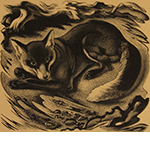
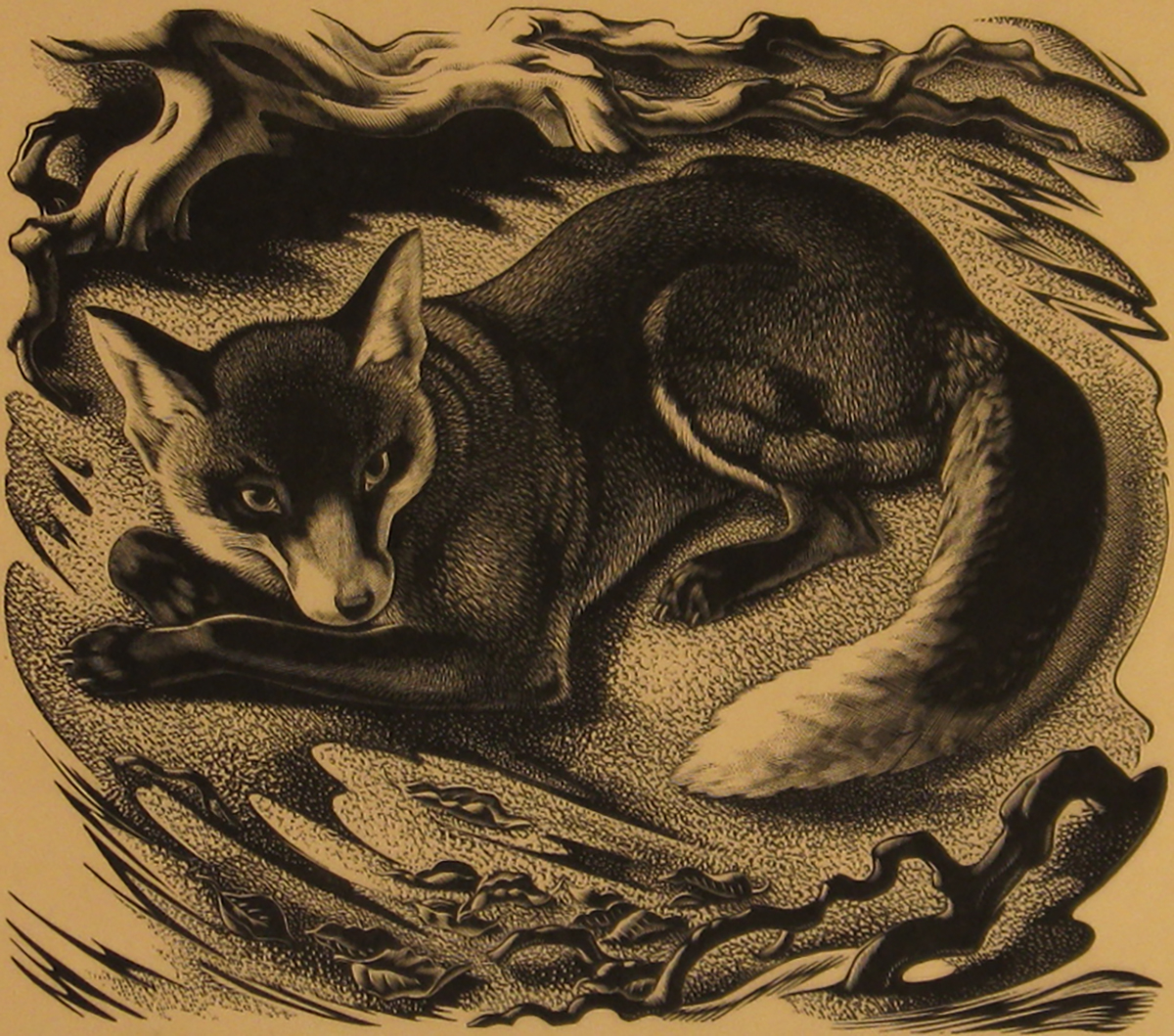
“Fox” by Agnes Miller Parker, 1940, Wood Engraving on Paper, Gift of Paul Gardner, Roswell Museum Collection, 1955.015.0001
What can a fox tell us about the connection between an early 20th century Scottish printmaker and the Roswell Museum? Often unfairly characterized as deceitful in western cultural traditions, the fox also represents intelligence under duress. A print by Agnes Miller Parker in the Roswell Museum’s collection, Fox can tell us about more than its maker. It also makes visible the relational networks of art circulation between individuals and institutions.
The fox is a symbol of resilience, navigating constraints through persistence and resourcefulness.
Artist Agnes Miller Parker was born in 1895 in Irvine, North Ayrshire, Scotland, the oldest of eight children. Her parents were supportive of her artistic aspirations, but also expected her to accept the traditional role of women at the turn of the century. She studied painting and drawing at the Glasgow School of Art 1911-1917 and she taught there briefly afterward. In 1918, she married fellow art student William McCance, who was a conscientious objector during World War I.
In 1920, Miller Parker and McCance moved to London, where they became inspired by the Vorticists. Aesthetically and conceptually connected to the continent’s Cubism and Futurism, Vorticism was distinctly British. Led by Wyndham Lewis, the Vorticists published their manifesto in Blast magazine in 1914. Forms of traditional pictorial representation were rejected in preference of bold geometry, lines, and colors attempting to capture modernizing society and drawing a viewer’s eye toward the center of compositions. The influence of Vorticism can be seen in Miller Parker’s paintings of this period.
Shortly thereafter, Miller Parker’s artistic focus shifted from painting to printmaking. She exhibited prints with the English Wood Engraving Society starting in 1926. She moved to rural Wales in 1930 to work at Gregynog Press where McCance became controller and Miller Parker became illustrator. This period was transformative for Miller Parker as she achieved significantly more recognition of her prints than she had of her earlier paintings. She was elected into the Society of Wood Engravers in 1932 and into the Royal Society of Painter-Printmakers in 1939.
The shift from urban to rural also translated into increasing isolation and relational conflict. Miller Parker and McCance moved into an abandoned windmill in Albrighton, Shropshire in 1933 where daily life was shaped by the elements and the limitations of their shelter. Over time, their relationship similarly became untenable. They separated in 1955 and finally divorced in 1963. Monmouth University English professor Kristin Bluemel wrote in Art Herstory earlier this year about the presence of Miller Parker’s brothers in her relocation to Glasgow “to escape a husband who had become increasingly controlling and abusive.”
In 1958, Miller Parker is quoted as saying “I am looking for a house in the country, or by the sea… I’d like to live on an island best of all.” Bluemel noted the artist’s relocation to the Isle of Arran where “she found happiness as a single woman working, fishing, sailing, and swimming. Wood engraving allowed her to accomplish what relatively few women in human history have been able to achieve: independent life as a professional artist.” Known as “Dolly” by locals, Miller Parker continued living on Arran for decades. She died in 1980 in Greenock, Scotland and was subsequently buried on Arran.
The fox is a symbol of ingenuity, solving problems through intelligence.
Agnes Miller Parker not only became a noteworthy printmaker, she is specifically recognized for her skill in and contribution to the craft of wood engraving. She was never formally trained in the practice of wood engraving, which makes her success even more remarkable. Biographical sources note she found inspiration in the copper engravings of Northern European printmakers from the late fifteenth and early sixteenth centuries.
For a 2016 exhibition connected to the Cambridge University Library Special Collections, Anna McGee noted the practice of wood engraving was popular until it was eclipsed by methods of photomechanical reproduction due to greater efficiency and cost effectiveness. McGee explained that “by the early twentieth century the practice of wood engraving came back into vogue as the scope it provided for artistic expression was recognized.” This likely closely preceded Miller Parker’s move to Wales to illustrate for Gregynog Press.
Wood engraving is a relief printmaking technique and a form of xylography. It is distinct from woodcut printing in that wood engraving uses a much harder block of wood. Woodcut printing uses a plank cut along the length of the tree (long grain) and the artist cuts with the grain, removing material from the surface with knives and gouges. Wood engraving printing uses a block cut across the trunk (end grain) and the artist cuts across the grain, typically with a burin, cutting fine lines into the hard, dense surface. Bluemel noted that “images produced by impressing engraved and inked woodblocks upon paper typically appear as white lines shining through black ink, creating tones of grey and silver through illusions of line and light.”
For the 2017 exhibition A New Era: Scottish Modern Art 1900-1950 at the National Galleries of Scotland, Alice Strang wrote “Miller Parker’s… part-simplification, part mechanisation of form, realised through the acute observation and skillful orchestration of human and animal interaction is remarkable.” This is not indicative of all wood engraving, but instead highlights Miller Parker’s mastery of it. In the text accompanying Fox, McCance wrote “each stage of the process of execution must be seen ahead. In consequence, the artist is compelled, by the medium itself, to have in mind the full conception and unity of the finished work before the surface is touched.”
Miller Parker was an active wood engraver and produced illustrations for a staggering number of publications from the early 1930s to the late 1960s. Her collaborations with HE Bates, Through the Woods (1936) and Down the River (1937), are among her most lauded works. Other notable works she illustrated include The Fables of Esope (1933), Elegy Written In A Country Churchyard (1940), Richard II (1940), The Faerie Queen (1953), The Tragedies (1959), and William Shakespeare’s Poems (1967).
The fox is a symbol of adaptability: surviving by responding tirelessly to the challenges of its circumstances.
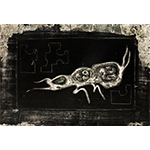
Agnes Miller Parker’s Fox was printed in an edition of 250 in 1940, published by the Woodcut Society in Kansas City, Missouri in 1941, and donated to the Roswell Museum by Paul Gardner in 1955. Printed on a warm, cream-colored paper, the composition is dominated by a fox lying on the ground, looking out at the viewer, as if it knows something we don’t. Exposed root structures surround the animal, beyond which are edges with expressive lines suggesting movement, perhaps turbulence.
The Woodcut Society was created in 1932 by Alfred Fowler, a commodities trader with a fondness for printmaking. Over the course of its 22 years, the Woodcut Society issued two editioned prints annually by artists both within and outside the United States. It had a membership-based printmaking subscription model that sought to introduce collectors to different printmaking practices and the artists who excelled at them.
Included with the Fox edition was a letter from Fowler explaining its distribution was delayed because of the bombing of London during World War II. “The block literally was engraved within sight and earshot of the dropping bombs,” he wrote. An introduction by McCance was also included with the print. He likened the fox’s adaptability to the resolve of British artists at the time. “They have marched on building up an edifice of culture amid the destruction that is taking place around them, so that a world, exhausted and battered after the battle is finished, may know that there are certain permanent values, which neither bombs, bullets, shells, nor propaganda can destroy,” he wrote. “When you look at this engraving of a fox, then look upon it also as a symbol of the attitude of the British artists during the war.”
It is likely that Paul Gardner acquired Fox through a Woodcut Society subscription. Gardner was the first director of what is now the Nelson-Atkins Museum in Kansas City. He was a soldier in the US Army in both world wars. In the latter, he was one of the “Monuments Men,” a group of service members who actively sought to save European art and architecture from destruction. He retired from the Nelson-Atkins Museum in 1953 to his ranch in San Patricio, New Mexico, Las Milpas. Artists Peter Hurd and Henriette Wyeth were his neighbors to whom he eventually sold his property. Gardner donated a number of works on paper to the Roswell Museum in the 1950s.
Fox was last on display in the 2022-2023 exhibition A Lasting Legacy: 85 Years of the Roswell Museum. It was in storage at the time of the flood and not directly impacted by the floodwaters. It, along with thousands of other works on paper, were recently shipped to a conservation laboratory in Minneapolis to be assessed for humidity exposure and rehoused. Like artists who continued resolutely to make art during the destruction of London, Fox can also represent the Roswell Museum and its resolve to carry on during a time of turbulence toward a brighter day ahead.
The statement “It’s Your Art” is meant to emphasize that the Roswell Museum’s collection is your collection. Despite the museum’s closure due to the October 2024 flood, staff continue to work behind the scenes on care for and conservation of collection objects. Please stay tuned for more from the Roswell Museum. We appreciate the outpouring of support from the community during our closure. And remember, “It’s Your Art.”