by Aaron Wilder, Curator of Collections and Exhibitions at the Roswell Museum
Roswell Daily Record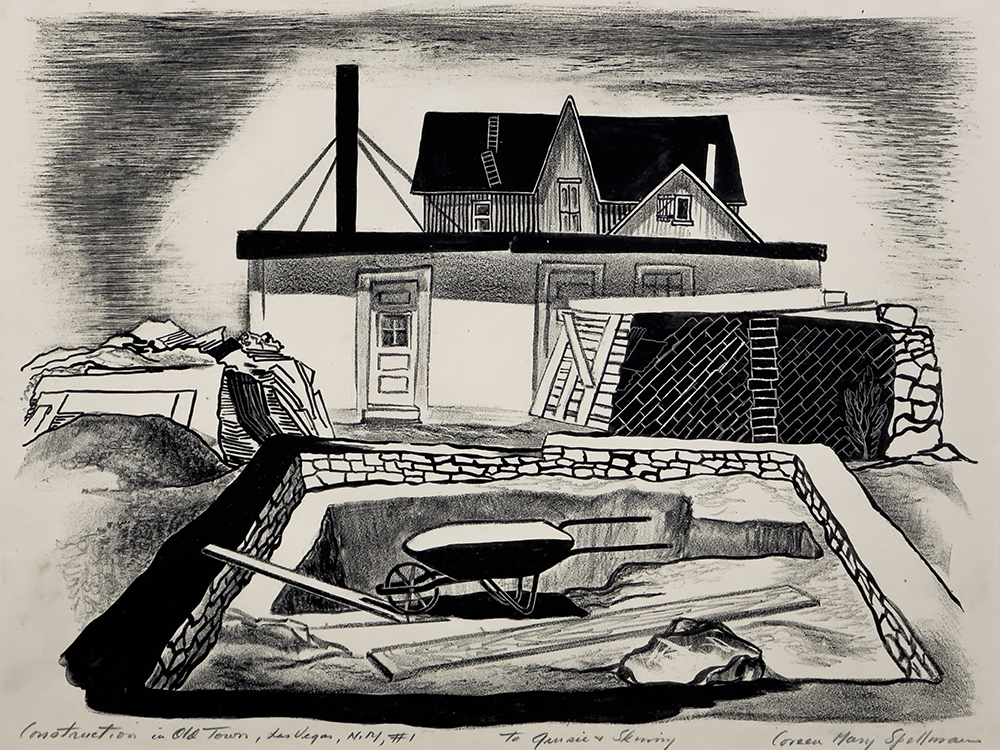
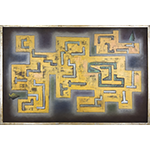
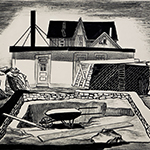
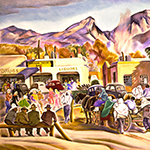
“Construction in Old Town Las Vegas, NM, #1” by Coreen Mary Spellman, Date Unknown, Lithograph on Paper, Found in Collection, 2010.008.0003
Texas artist Coreen Mary Spellman spent her life dedicated to arts education, both for her own professional development and to enable young women printmakers to achieve a more inclusive art world.
Spellman was born May 17, 1905, in Forney, Texas, to Michael and Carrie Huffines Spellman. At age two, she moved with her family from their farm on Irish Ridge to a house at 400 South Center Street. She was the second of six children. Her father combined farming with banking, while her mother oversaw the household.
Her formal art training began early. In the summer of 1918, at thirteen, she took private lessons with Dallas artist Vivian Aunspaugh. After graduating from Forney High School in 1921 at sixteen, she enrolled at the College of Industrial Arts (now Texas Woman’s University—TWU) in Denton, earning a Bachelor of Science degree in costume design in 1925. She continued her studies the following year at Columbia University’s Teachers College, where she encountered modernist ideas that would influence her work.
Returning to Denton in 1926, Spellman joined the faculty of TWU as an art instructor. She remained committed to further study, attending Harvard University in the summer of 1927 through a Carnegie Foundation program focused on art history and museum practice. After teaching during the 1927–1928 academic year, she took leave to study full time at the Art Students League in New York.
Her work soon gained wide recognition. In 1931, a lithograph of a reclining nude was selected by the American Institute of Graphic Arts as one of the year’s fifty best prints and appeared in Art Digest in April 1932. The composition shows a woman stretched across a bed, looking out a window, with a book turned face down beneath her left hand. That same year, Spellman studied in Mexico City and presented a solo exhibition at the Dallas Museum of Fine Arts.
Exhibitions followed in quick succession. In 1933, she held three solo shows at different Texas institutions. In 1936, the American Artists Congress included one of her mezzotints in a major exhibition of contemporary American prints shown simultaneously in thirty cities across the country.
In 1939, after a colleague was denied membership in the male-only Lone Star Printmakers, Spellman joined seven other women in organizing an alternative: the Printmakers Guild. The group sought both to promote public understanding of printmaking and to create exhibition opportunities for women artists. Later renamed the Texas Printmakers, it remained active for twenty-five years.
Spellman again took leave from teaching in 1941–1942 to complete work toward a Master of Fine Arts degree at the University of Iowa, then the first institution in the United States to offer the degree. Over time, she expanded her professional activities to include lecturing, illustrating children’s publications, and traveling extensively, including trips to the British Isles and the Middle East. She also spent many summers teaching in New Mexico.
Alongside her long career at TWU, where she taught from 1926 until retiring in 1974, she taught at the Dallas Museum of Fine Arts school during the 1940s and held visiting appointments at Sam Houston State Teachers College, Sull Ross State Teachers College, and New Mexico Highlands University (NMHU). Despite her sustained contributions, TWU never promoted her to full professor of art. She passed away on October 15, 1978.
D. Jack Davis outlined the details of Spellman’s education and career in the 2024 book Making the Unknown Known: Women in Early Texas Art, 1860s-1960s. He described Spellman as “systematic and meticulous in her approach to artistic problems; her work was informed by extensive research, careful planning and insight, and executed with careful attention to detail.”
He also explained the alignment of Spellman’s work with that of the precisionist movement, which “originated in the late 1920s after World War I and was at its height during the interwar period. Influenced strongly by cubism and futurism, its main themes included industrialization and modernization… which were depicted in precise, sharply defined, geometrical forms.”
The lithograph entitled Construction in Old Town, Las Vegas, N.M. #1 is inscribed with the note “To Gussie & Skinny,” indicating this print was either given by Spellman to them or they purchased it from her. Either way, the personal note shows a familiarity between the artists.
Gussie DuJardin was a Roswell Artist-in-Residence 1977-1978. Her husband, Elmer Schooley was also a resident at that time and he taught at NMHU in Las Vegas 1947-1977. He was also the chair of the art department at NMHU while Spellman taught there as an intermittent summertime visiting professor.
In the foreground of the lithograph is a construction site where a building with a brick wall has started to be constructed. A wheelbarrow’s front wheel is positioned on a 2x4 serving as a ramp up and onto the brick wall in-progress. In the background is a short structure with a flat roof and large plume and a sizable house with a pitched roof is beyond that. While the house in the background looks complete, the presence of ladders on its roof indicates its construction may have just concluded.
Spellman had a fondness for depicting in her art the happenings of everyday life. In her Foltz Fine Art biography, she’s quoted as saying, “I enjoy taking some rather obscure or unimportant subject or theme and making something fine and important out of it… It always gives me great pleasure to discover something which has been passed over as being inadequate material.”
In addition to the Roswell Museum, Spellman’s art is in many museum collections, including the Brooklyn Museum in New York, the Dallas Museum of Art in Texas, the Joslyn Museum in Nebraska, the San Antonio Museum of Art in Texas.
The statement “It’s Your Art” is meant to emphasize that the Roswell Museum’s collection is your collection. Despite the museum’s closure due to the October 2024 flood, staff continue to work behind the scenes on care for and conservation of collection objects. Please stay tuned for more from the Roswell Museum. We appreciate the outpouring of support from the community during our closure. And remember, “It’s Your Art.”




.jpg)


.jpg)