
by Aaron Wilder, Curator of Collections and Exhibitions at the Roswell Museum
Roswell Daily Record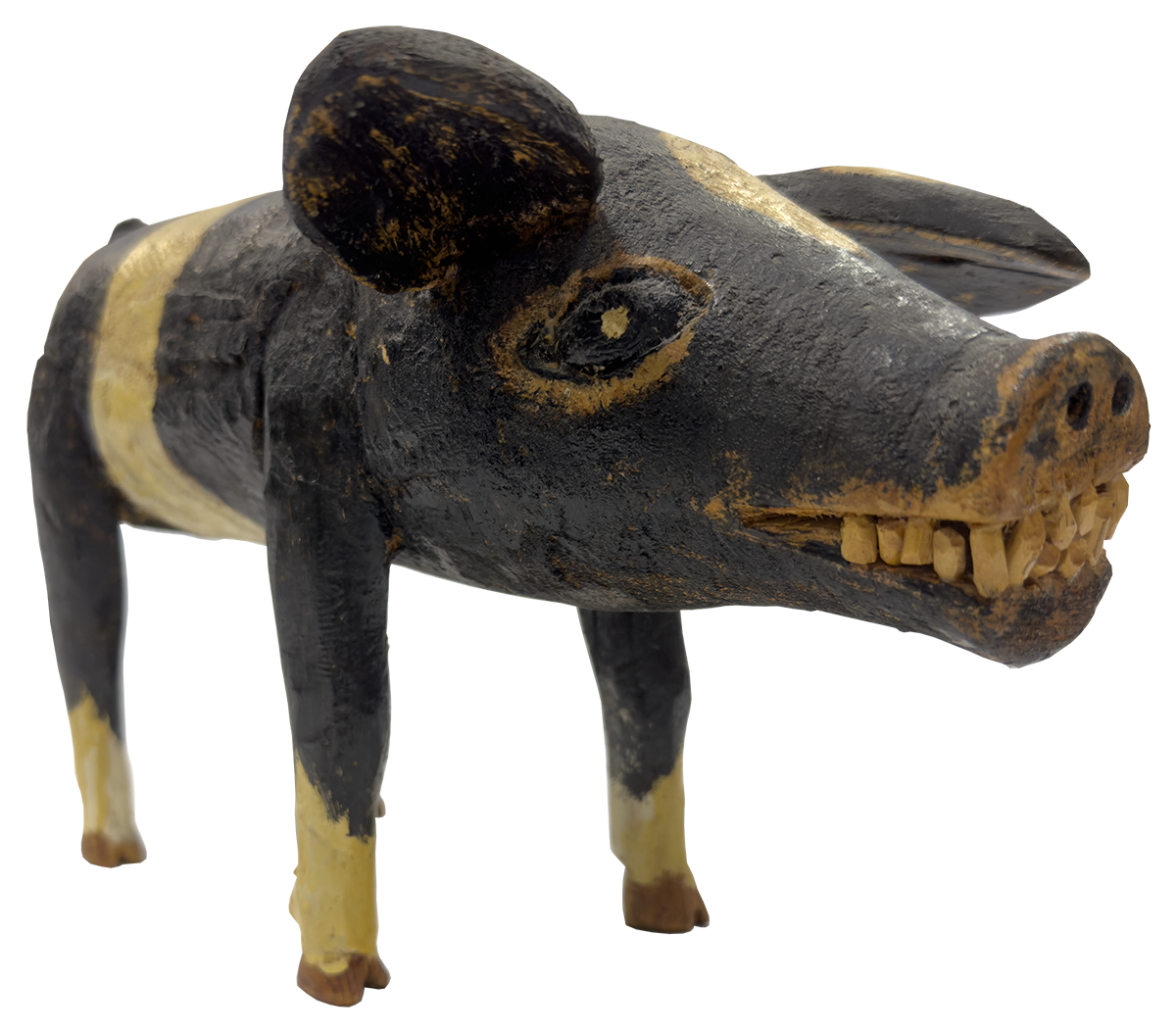
“Piglet” by Felipe Archuleta, Circa 1971-1972, Paint on Carved Wood, Gift of Wendell Ott, 2023.007.0001
The sculptor Felipe Archuleta was as irreverent and unconventional as his carved creatures. Collector and friend Murdoch Finlayson recalled, “He’d dye his hair purple, drive his pickup right up to the steps of the Museum of Fine Arts, and do just about anything he’d damn well please.”
Born in 1910 in northern New Mexico, Archuleta was the oldest of six children. Sources differ on the precise location of his birth, variously identifying Santa Cruz, San Pedro, and the Sangre de Cristo Mountains. His childhood was marked by poverty and responsibility. He left school after only a few years and worked from an early age to feed his siblings. He picked potatoes and chiles, herded sheep, and later worked as a laborer, cook, and truck driver for the Civilian Conservation Corps during the Great Depression.
After learning carpentry and joining the United Brotherhood of Carpenters and Joiners of America in 1943, Archuleta took great pride in his work. But in the mid-1960s, after a disagreement with the union and a period when he could not find enough work to support his family, he experienced a kind of religious awakening. Sources differ on whether he began carving in 1964 or 1967.
According to Archuleta, he prayed to God to relieve his poverty. His perception of the celestial response was that he was to “carve wood.” Archuleta did not believe himself worthy to become a santero, or carver of religious figures, so he chose to carve animals instead. Entirely self-taught, he initially carved during the winter, when construction work was unavailable, and sold the sculptures to supplement his income.
He drew inspiration from domestic and wild animals, as well as photographs in National Geographic and images from the television program Mutual of Omaha’s Wild Kingdom. In a 2014 interview published in El Palacio, his grandson Ron Archuleta Rodríguez recalled seeing his grandfather’s apprentices studying pictures of animals as they worked. “They would look and carve and look and carve,” he remembered. Archuleta encouraged them to pay close attention: “Look at what you are carving. Look at what you were doing. God gave you a mind—use it.”
His animals are distinctive for their irregularly carved teeth, wide-eyed stares and exaggerated physical features. Charlene Cerny, then director of the Museum of International Folk Art in Santa Fe, wrote in 1991, “His animals refuse the definitions and illusions and fantasies we have about animals. His gorilla is special because it apes. His animals, be they domesticated or wild, confront us with their ferocity, irony and wit. Their candid brutishness challenges us and the world we have created, where entire species are being lost to eternity—a world in which our children must be taught our milk does not come from plastic jugs. His animals are not passive, they gaze back at us, they interact with us and they remind us of our disrupted relationship with the natural world. A viewer cannot just pass them by, and they are not easy to consume.”
Piglet in the Roswell Museum’s collection demonstrates precisely this tension. At first glance, there is something almost endearing about the little animal. Its eyes are recessed directly into the wood, its tail is made from a piece of frayed rope, and its body is painted black and white. Look closer, however, and its red-stained teeth introduce something more unsettling. The piglet is familiar and friendly-looking, but also distinctly Archuleta.
Archuleta’s process could begin with almost anything nearby. “Archuleta usually grabbed whatever material was closest at hand to draw a rough sketch of whatever he was about to set out to carve,” wrote John Villani in The New Mexican in 1992. His sketches might appear on notebook paper, a scrap of wood, a pizza box, dinner napkin, or cigarette carton.
His backyard workshop in Tesuque was filled with cottonwood and Chinese elm logs, sawdust, and wood shavings. He obtained materials from dumps and neighbors, transforming discarded objects into features of his animals. Bottle caps became snake bodies, pieces of Clorox bottles became claws, and brooms, rubber combs, rope, and wire became teeth, whiskers, tongues, and manes. He used chainsaws and rasps alongside glue, nails, and ordinary house paint.
The artist described the process of making a pig in a 1978 transcribed artist statement: “This is a headache making these woodcarvings. I hate to start these things, but I have to pay the bills. And I have to satisfy the people… First, with a chainsaw or an axe, you cut the shape of the pig—the head and the body. Then you use a rasp to make the body smooth. Maybe you make the legs out of four good logs next, or maybe you make the ears. Sawdust and glue is how you put them on, and nails; then the teeth and tongue.”
Piglet, made circa 1971-1972, is one of four sculptures by Archuleta in the Roswell Museum’s collection. Measuring approximately 8x8x15”, it was donated to the museum in 2023 by Wendell Ott, who served as the museum’s director during the 1970s and 1980s. Ott purchased it from a gallery on Canyon Road in Santa Fe before eventually giving it to the museum as part of a gift of eight artworks.
By the height of Archuleta’s reputation, demand for his animals had become overwhelming. He told Davis Mather, “It looks easy making these things no? But it isn’t. You can see how much time it is. And the people, they still come more and more. I make these things not for the money, but to get rid of the people. What good is being famous if I no longer be here much longer. You know, too much work to satisfy too much people.”
Archuleta carved his last major work in 1987 and died as a result of having a brain tumor in 1991. His work was exhibited internationally, including at the American Embassy in Paris and in Tokyo for the nation’s bicentennial. He inspired younger New Mexican wood carvers, including Alonzo Jiménez, David Alvarez, and his son Leroy Archuleta.
Today, his sculptures are held by museums including the American Folk Art Museum in New York, the Menil Collection in Texas, the Museum of International Folk Art in New Mexico, the Sheldon Museum of Art in Nebraska and the Smithsonian American Art Museum in Washington, DC.
The Roswell Museum now has four examples of Archuleta’s remarkable menagerie: a raccoon made in 1979 and acquired that year; a pig and a snake acquired in 1994; and Piglet, the most recent addition. Because it was acquired less than a year before the October 2024 flood that devastated the Roswell Museum, Piglet was in storage and was not directly impacted by the floodwaters.
“It’s Your Art” emphasizes that the Roswell Museum’s collection is your collection. Although the museum remains closed, its staff continue working behind the scenes to care for and conserve its collection. Piglet, with its humble materials, friendly appearance and unexpected stained teeth, remains a small but remarkable example of the art that belongs to Roswell.












.jpg)






.jpg)