by Aaron Wilder, Curator of Collections and Exhibitions at the Roswell Museum
Roswell Daily Record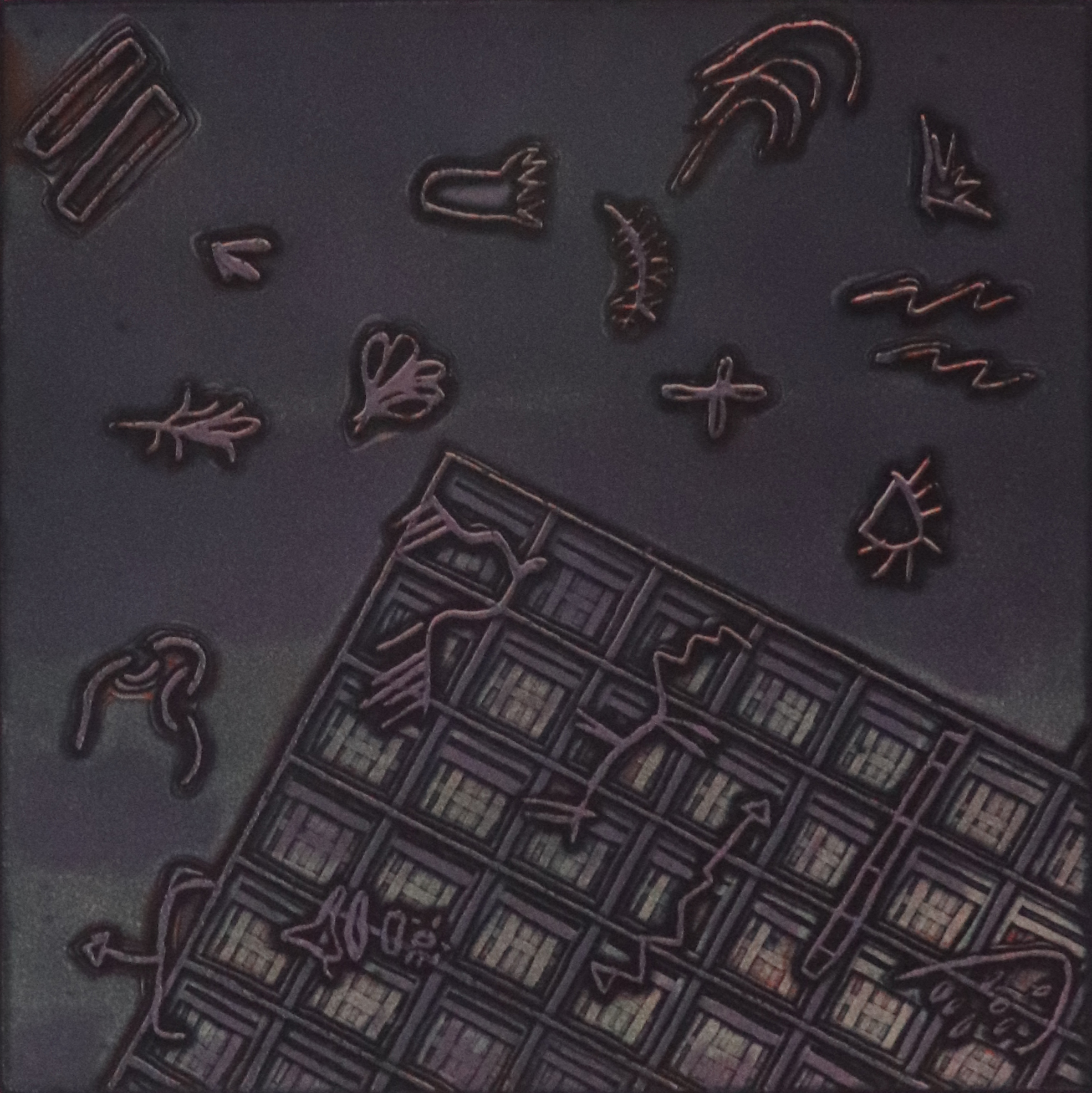
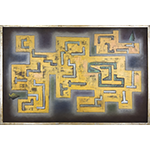
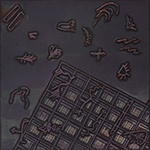
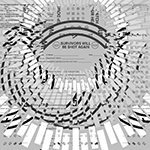
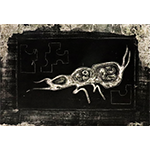
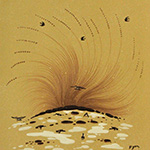
“Three Rivers” by Susan Bremner, 1982, Intaglio Print on Arches Paper, June Middleton Estate Fund Purchase, 1982.035.0001
Compositions in the art of printmaker Susan Bremner combine multiple elements; fields of ink that settle into place as naturally as sediment. “My intention is the evocation of natural experience through shape, texture, pattern and color,” Bremner explained in an exhibition brochure for a 1982 exhibition, a statement that still offers a useful entry point into her work.
Born in Anchorage, Alaska, in 1950, Bremner received her bachelors degree in art in 1972 from Central Washington State College and masters degree in printmaking in 1980 from California State University, Long Beach. By the time she became a Roswell Artist-in-Residence (RAiR) in 1981, she had developed a distinctive technical approach. Her intaglio etchings are printed from a single metal plate, with multiple colors applied simultaneously through viscosity printing (a demanding process that relies on careful manipulation of ink density and the use of different rollers). The result is a layered surface in which color relationships feel embedded rather than superimposed.
Her time in Roswell proved to be a generative period. In a 1982 Roswell Daily Record article, Resident Artist Program Unique, Jeanne Neill quotes Bremner as saying “I’ve gotten a lot of work done here. I’ve done the equivalent of several years work because all I’ve had to do is my work. This has been a rare opportunity. Even when I was going through graduate school I had one or two part-time jobs.”
During this time, she began a suite of prints inspired by the landscape of the Pecos River Valley. In a 1982 exhibition brochure, the artist is quoted as saying “While living in Roswell I began a suite of prints in celebration of life in the Southwest, and the Pecos River Valley, in particular. In this series I have drawn upon my feeling for the landscape and the sense of history which permeates the unchanging prairies.”
One work from this period, Three Rivers, suggests both the strengths and the complications of Bremner’s practice. Roswell Museum curator Wesley Rusnell wrote in 1982: “Three Rivers uses a tilted grid to create an emphatic mountain profile that wedges its triangle into a night sky. The sky dances with jots that suggest rock-art imagery found in the Southwest. There is a playfulness in all this with a nod to myths of ancient people.”
Approximately 90 miles from Roswell, the Three Rivers Petroglyph Site contains more than 20,000 carvings created by the Jornada Mogollon people. These images are not simply creative expression; they are part of a cultural and historical record that remains meaningful to descendant communities. When such imagery appears in a contemporary artwork, it brings with it questions that extend beyond formal composition. About Three Rivers, the artist is quoted as saying “Above the triangle float figures borrowed from Indian petroglyphs. Some are actual symbols and some are imaginary.”
Art historians have described appropriation as a defining feature of modern and contemporary artistic practice, often tied to broader histories of colonialism and collecting. As John C. Welchman has argued in Global Nets: Appropriation and Postmodernity in 2001, appropriation involves the “relocation, annexation or theft of cultural properties,” a process closely linked to the development of museums themselves. Similarly, Ariella Aïsha Azoulay, in her 2019 book, Potential History: Unlearning Imperialism, has written about the ways in which objects and images have been removed from their original contexts under the justification of preservation, even as that removal can strip them of their cultural protections and meanings.
These perspectives can help us think more critically about Bremner’s Three Rivers. Her use of petroglyph-inspired forms reflects a broader tendency among 20th-century artists to draw from Indigenous cultures of the Southwest, often motivated by admiration, curiosity, or a search for symbolic resonance. At the same time, such borrowing exists within an uneven historical relationship, one in which Indigenous cultures have frequently been treated as open resources rather than as living traditions with specific custodians.
To acknowledge this tension is not necessarily to assign intent or to reduce Bremner’s work to a single issue. Her prints remain deeply engaged with material, process, and place; they are records of sustained looking and technical experimentation. Yet they also participate in a larger story about how artists encounter and reinterpret the cultural landscapes around them.
Museums, including the Roswell Museum, are part of that story. As institutions that collect, preserve, and interpret objects, they inevitably shape the narratives through which artworks are understood. Presenting Bremner’s work today invites not only an appreciation of her skill and vision, but also a consideration of the histories (artistic, cultural, and institutional) that inform it.
In this sense, Three Rivers can be seen as both as both a beautiful object and a point of dialogue. It reflects an artist responding to the visual and historical environment of the Southwest, while also prompting us to ask how those responses are formed, what they draw upon, and how they resonate in the present.
After her time at RAiR, Bremner was awarded fellowships at MacDowell Colony in New Hampshire in 1985 and Kala Institute in California in 1987. In addition to the Roswell Museum, Bremner’s work is in the public collections of the Alaska State Museum and the Anchorage Museum of History and Art as well as a number of private collections.
The statement “It’s Your Art” is meant to emphasize that the Roswell Museum’s collection is your collection. Despite the museum’s closure due to the October 2024 flood, staff continue to work behind the scenes on care for and conservation of collection objects. Please stay tuned for more from the Roswell Museum. We appreciate the outpouring of support from the community during our closure. And remember, “It’s Your Art.”



.jpg)


.jpg)