by Aaron Wilder, Curator of Collections and Exhibitions at the Roswell Museum
Roswell Daily Record
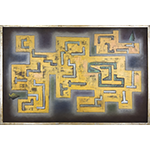
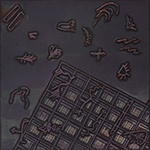
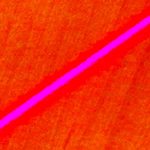
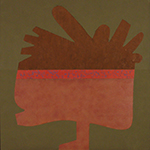
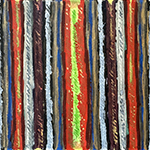
“The Mouse in the Corner” by Jorge Fick, 1972, Oil on Canvas, Acquisitions Fund Purchase, 1974.032.0001
As a painter, poet, and Zen Buddhist, Jorge Fick viewed his work as being in touch with the environment around him. “The paintings that I am doing now look like paintings of things, when they are really paintings of energy.,” said Fick. “It’s the same energy nature gives us, and it’s the metaphor of the way nature gives it to us that’s in the painting.”
Jorge Fick was born in Detroit in 1932 as George Fick to Roman Catholic parents. In a 10/17/2019 entry on LakeChapalaArtists.com, Tony Burton noted that 1947-1950, “Fick attended Cass Technical School, a public trade school in Detroit” and studied graphic design. During this time he was also exposed to the collection of the Detroit Institute of Arts. 1950-1951, Fick continued his education at the Society of Arts and Crafts in Detroit. His studies then took him to Mexico, first to Guadalajara and then to nearby Ajijic in 1951. “In the early 1950s, Ajijic was a center for art classes marketed primarily to the US,” explains Burton. It was during this period that he changed his first name from George to Jorge in 1951.
Burton notes that “His decision to study at Black Mountain College (BMC) immediately after Ajijic is especially interesting and may well have been prompted by one of his teachers in Mexico. The art workshops in Ajijic were led by local artist Ernesto Butterlin, ably assisted by ‘Nick’ Muzenic. Alexander Nicolas Muzenic (1919-1976) had studied at Black Mountain College, under the legendary Josef Albers, from about 1945 to 1948 before moving to Ajijic.”
1952-1955, Fick studied at BMC, where he received a BFA, becoming one of the few students to graduate. BMC existed 1933-1957. Founded by John Andrew Rice, it was conceived as an experimental educational environment led by its faculty. Josef Albers, who arrived from the Bauhaus in Germany, was asked to develop the school’s arts curricula. The school has often been described as an “open laboratory” where disciplines weren’t siloed and where music, theater, visual art, and writing informed each other.
Fick’s time at BMC included mentorship from influential artists such as Franz Kline, Joseph Fiore, Philip Guston, Jack Tworkov, Esteban Vicente, and Peter Voulkos. His relationship with Kline formed early on at BMC. He invited Fick to exhibit his work at the Stable Gallery in New York City in 1953 while Fick was still a student. Art historian Robert S. Mattison, who co-curated the Loretta Howard Gallery’s exhibition Black Mountain College and Its Legacy in 2011, wrote: “The organic shapes of Volkos’ ceramics and their allusion to the cycles of nature are germane to Fick’s works. At BMC, Fick began a lifelong interest in Zen Buddhism which encouraged him to seek out underlying forces in the natural world.” After graduating, Fick shared a studio in New York for a period of time with Kline, who encouraged him to explore abstract expressionism.
In 1958, Fick moved to Santa Fe, where he would spend the remainder of his life, dividing his time between Santa Fe and Taos. In New Mexico he shared a studio with sculptor John Chamberlain. During the 1960s, Fick’s work extended beyond painting. Burton wrote “Fick also printed Eliot Porter’s environmental photographs (1962-1968) [and] acted as a color consultant to architect-designer, Alexander Girard, responsible for the rebrand of Braniff Airlines.” 1969-1983, Fick operated “The Fickery,” a gallery and art space at 720 Canyon Road in Santa Fe. He ran it with his then-wife, Cynthia Homire, a fellow BMC student. Homire made the stoneware and Fick glazed it.
In 1972, Fick created the painting The Mouse in the Corner, now part of the Roswell Museum’s collection. The work shows his skill in design and his expertise in color consulting. The composition presents an abstract form, interpretable as his depiction of a mouse, beneath a triangle, which can be read as a corner. The Roswell Museum purchased the painting in 1974. It was most recently on view in the exhibition ShapeShift: Abstracted Geometric Forms November 19, 2022 – May 28, 2023. A 2001 sculpture, also titled The Mouse in the Corner, is in the collection of Harwood Museum of Art and is likely Fick’s humorous take on a computer mouse. Fick’s painting was in storage at the time of the October 2024 flood and was, thankfully, not directly impacted by the floodwaters.
Fick died in Santa Fe in 2004. Today his work can be found in the collections of the Harwood Museum of Art, the New Mexico Museum of Art, the Phoenix Art Museum, the Smith College Museum of Art, and the Whitney Museum of American Art, in addition to the Roswell Museum’s collection.
The statement “It’s Your Art” is meant to emphasize that the Roswell Museum’s collection is your collection. Despite the museum’s closure due to the October 2024 flood, staff continue to work behind the scenes on care for and conservation of collection objects. Please stay tuned for more from the Roswell Museum. We appreciate the outpouring of support from the community during our closure. And remember, “It’s Your Art.”