by Aaron Wilder, Curator of Collections and Exhibitions at the Roswell Museum
Roswell Daily Record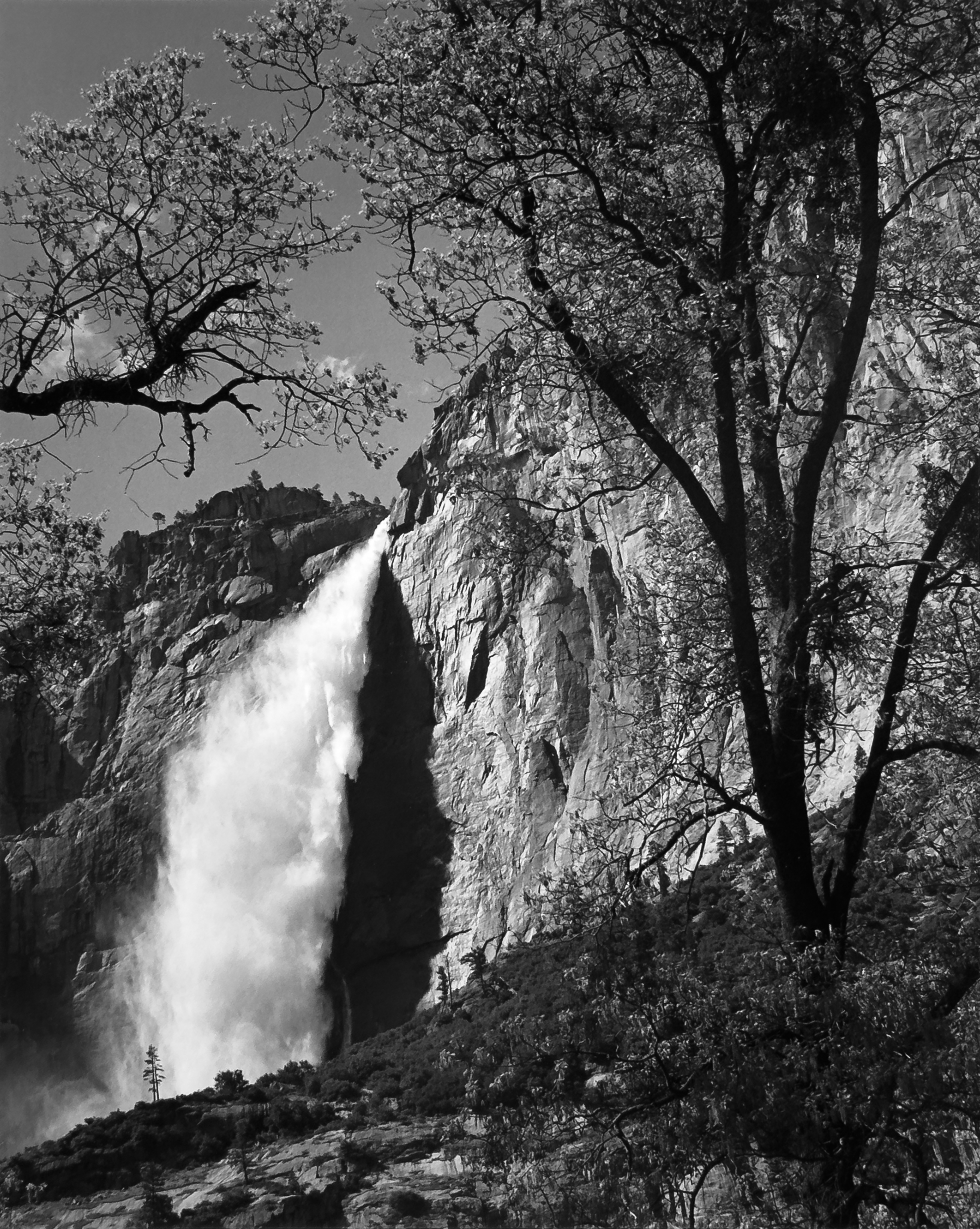
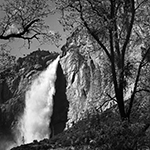
“Yosemite Falls, Spring, Yosemite National Park” by Ansel Adams, 1983, Silver Print on Paper, Gift of Lucile Batten, 1983.023.0001
There are few photographs of the American landscape as recognizable as those of Ansel Adams. His black and white prints of mountains, rivers, trees, and waterfalls have become so familiar that it can be easy to forget that they are photographs, not the landscapes themselves. The Roswell Museum’s collection includes one of those images, Yosemite Falls, Spring, Yosemite National Park. In it, Yosemite Falls descends through a landscape of trees and rock. The scene is monumental but also quiet, rendered in the rich range of grays characteristic of Adams’ work.
Although his photographs are remarkably precise, he did not consider them simply realistic records of what stood before his camera. In a 1983 interview, he explained that his Yosemite photographs were “not ‘realistic,’” but rather an “imprint” of his visualization. He wanted a photograph to convey not only the forms he saw but also what he had seen and felt at the moment he took the picture. His photographs were the result of decisions about composition, light, exposure, development, and printing. He worked with large-format cameras and developed the Zone System, a method for controlling the range of tones from black to white. The negative was not the end of the process; the final print was another opportunity to realize the image he had imagined.
Adams put it another way in the 1983 interview: “There are always two people in every picture: the photographer and the viewer.” The photographer in this case was a man whose way of seeing was shaped by several different disciplines. Born in San Francisco in 1902, Adams became seriously interested in music as a boy and spent years studying piano, initially imagining a career as a classical musician. His early training gave him a respect for technique and discipline that would remain evident in his photographic work.
His first visit to Yosemite, at age 14, changed the direction of his life. He returned repeatedly, eventually spending summers there with the Sierra Club. Nature became both the subject of his photography and a personal passion.
New Mexico also played an important role in Adams’ early development. He first visited the state in 1927 and returned in 1929, when he photographed at Taos Pueblo as part of a book project with writer Mary Austin. During that period, he encountered a remarkable community of artists and writers, including Georgia O’Keeffe and John Marin. Most consequentially, he met photographer Paul Strand. Adams later recalled that the experience of seeing Strand’s negatives changed his direction completely and helped convince him to pursue photography full-time. Soon afterward, Adams became one of the leading advocates for “straight” photography. His work would become famous for its clarity and precision, but that precision should not be confused with neutrality.
A photograph has a frame, an edge. It includes some things and excludes others. Photographs have long carried an aura of objectivity. We tend to trust the camera to show us what was there. Adams’ work makes that assumption particularly interesting because his photographs can look so convincing. The mountains seem monumental. The light seems radiant. The landscape can appear timeless, pristine and untouched. Yet the photograph is not the landscape. It is one person's way of seeing the landscape.
This matters when we think about the American West and the idea of wilderness. Landscape is not simply scenery waiting to be discovered. What we recognize as a landscape is shaped by history, culture, and perspective. For centuries, European and American representations of the continent have often depicted Western places as vast, open spaces awaiting exploration, settlement, or use. That imagery could make existing Indigenous communities and their relationships to the land difficult to see; or invisible altogether.
People have lived in what is now Yosemite for thousands of years. Yosemite Valley was home to people who called themselves the Ahwahneechee, and the region has longstanding connections to Southern Sierra Miwuk, Central Miwok, Mono Lake Kootzaduka’a, Western Mono, Chukchansi Yokuts and Paiute peoples, among others. The descendants of these communities remain connected to Yosemite today. The National Park Service currently recognizes seven traditionally associated Tribes with ongoing relationships to the park. The absence of people in a photograph is not the same thing as the absence of people from a place.
Adams’ commitment to environmental conservation was genuine and substantial. He served for decades on the Sierra Club’s board, advocated for the protection of wilderness, and fought against development in Yosemite. When the National Park Service proposed reconstructing Tioga Road through the Yosemite high country in the 1950s, Adams joined the opposition. The road was ultimately built despite the protests.
Adams himself resisted the idea that he had made his photographs with the intention of environmental advocacy. In the 1983 interview he said, “I never did a photograph of any importance for an environmental purpose.” He made photographs because he was in a place he loved and because he imagined there the continuing imprint of how he felt. He acknowledged appreciation, however, that those photographs had subsequently been used in campaigns to protect landscapes. An important distinction is that an artist's intentions and an artwork's consequences are not the same thing.
Adams helped Americans see landscapes they might never have encountered in person. His photographs could inspire awe and, in turn, a desire to protect what they depicted. At the same time, the visualization of pristine wilderness can obscure the complicated histories of the places being photographed, including Indigenous presence, displacement, and continuing relationships to the land.
Adams himself understood that “wilderness” was more complicated than a patch of land without buildings or roads. In a 1970s oral history interview, he called wilderness “a mystique” and “a state of mind” that people enjoy in its supposedly pristine quality. That observation gives us another way to look at his photographs. They show us nature, but they also show us an idea of nature. And that brings us back to Yosemite Falls.
The photograph remains beautiful. Its beauty does not disappear when we learn more about how it was made or about the history of landscape representation. If anything, understanding Adams’ choices can make the photograph more interesting. We can admire the precision of the print while recognizing the subjectivity behind it. We can appreciate Adams’ commitment to protecting wilderness while asking what our cultural idea of “wild” has sometimes left outside the frame.
Most importantly, we can look at the photograph as Adams wanted us to look: not simply asking what the camera recorded, but considering what the photographer saw, what the viewer brings to the image, and what the frame allows us to notice. A landscape photograph does not tell us everything about a place. It gives us a way of seeing it. The rest is up to us.