
Fourteenfifteen Gallery
proudly presents
Declarations of Incongruence
A Group Show Featuring Artwork by 12 Artists, Curated by Aaron Wilder
July 3-31, 2026
Opening Reception: Friday July 3, 6:00pm-9:00pm
Closing Reception: Friday July 31, 6:00pm-9:00pm
Open Hours: Saturday-Sunday 2:00pm-8:00pm (except July 4)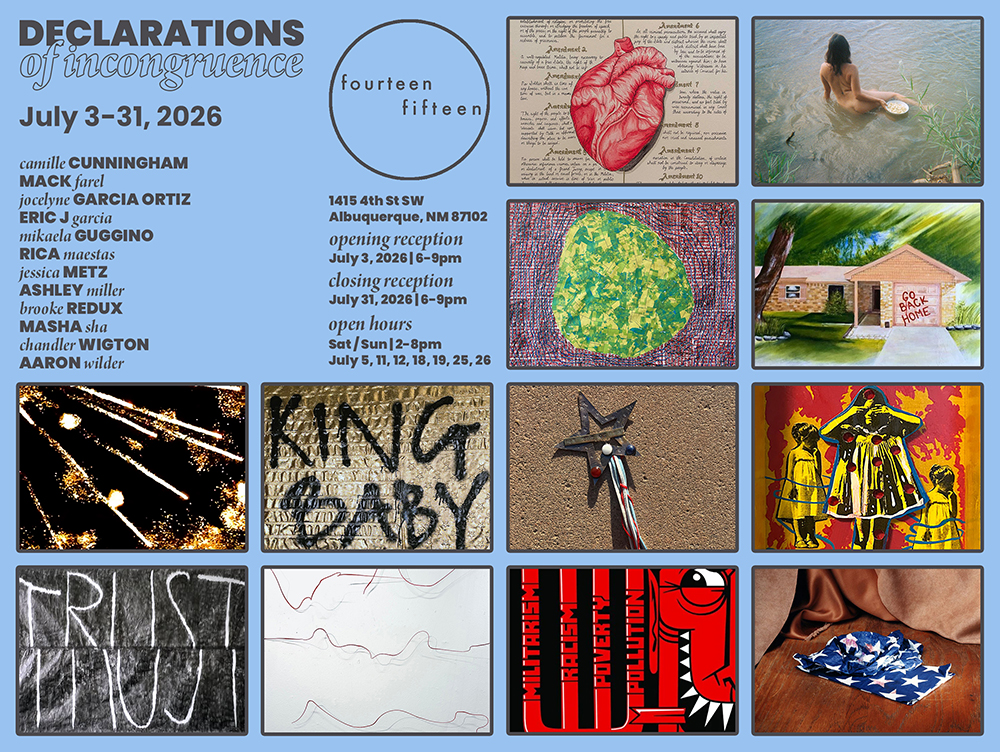
Press Release:
At a time of commemorations of the signing of the Declaration of Independence, Declarations of Incongruence draws attention to the document’s covert normalization of exclusion and exploitation. Despite 250 years of claimed progress, expanded inclusion, and justice for all, the Declaration’s true legacy continues in the erosion and erasure of cultures, identities, rights, and statuses not only at the federal level, but also perpetuated by state, county, and municipal governments. Curated by Aaron Wilder, this exhibition features artistic declarations that challenge, draw attention to, refuse, and embody resilience despite the perpetuation of incongruence between America’s founding mythology and historic, contemporary, and future realities.
The show features 12 artists: Camille Cunningham, Mack Farel, Jocelyne Garcia Ortiz, Eric J. Garcia, Mikaela Guggino, Rica Maestas, Jessica Metz, Ashley Miller, Brooke Redux, Masha Sha, Chandler Wigton, and Aaron Wilder. The work of each engages critically with the intentions and legacies of the Declaration of Independence, collectively corresponding to the group of land-owning, white male signers whose privileges were normalized in its text. Exhibited works include collage, drawing, painting, performance, photography, printmaking, sculpture, and video. Across these diverse media, the artists examine how language, land, bodies, and histories are entangled, while also exploring acts of refusal, survival, imagination, and care.
Fourteenfifteen Gallery is an artist-run, non-commercial exhibition space located in Albuquerque's historic Barelas neighborhood, on Tiwa land. We are devoted to supporting creative community and to giving experimental, underrepresented, and emerging artists and collectives a space where they can take chances with their work. The space we occupy has a 20+ year lineage of artist run galleries, including GRAFT, The Tan, The Normal, and Donkey Gallery. Fourteenfifteen Gallery is a D.I.Y. endeavor and a labor of love, operated and funded by the L.o.A. Collective.
Curatorial Essay:
At a time of commemorations of the signing of the Declaration of Independence, Declarations of Incongruence draws attention to the document’s covert normalization of exclusion and exploitation. Despite 250 years of claimed progress, expanded inclusion, and justice for all, the Declaration’s true legacy continues in the erosion and erasure of cultures, identities, rights, and statuses not only at the federal level, but also perpetuated by state, county, and municipal governments. Curated by Aaron Wilder, this exhibition features artistic declarations that challenge, draw attention to, refuse, and embody resilience despite the perpetuation of incongruence between America’s founding mythology and historic, contemporary, and future realities.
A Declaration is an explicit expression of feeling or commitment, implying boldness and clarity. It doesn’t just describe reality, it attempts to create one by shaping perception, asserting a claimed truth with conviction and authority, and seeking to initiate action. An Incongruence is the state of being unsuitable, inconsistent, or not fitting together properly, often describing a lack of harmony between ideas, feelings, or actions. It indicates a contradiction, such as a mismatch between words and behavior, or a conflict between an ideal self and actual experience.
The show features 12 artists: Camille Cunningham, Mack Farel, Jocelyne Garcia Ortiz, Eric J. Garcia, Mikaela Guggino, Rica Maestas, Jessica Metz, Ashley Miller, Brooke Redux, Masha Sha, Chandler Wigton, and Aaron Wilder. The work of each engages critically with the intentions and legacies of the Declaration of Independence, collectively corresponding to the group of land-owning, white male signers whose privileges were normalized in its text. Exhibited works include collage, drawing, painting, performance, photography, printmaking, sculpture, and video. Across these diverse media, the artists examine how language, land, bodies, and histories are entangled, while also exploring acts of refusal, survival, imagination, and care.
In Pray and Prey, Camille Cunningham examines the persistent gap between America’s professed commitments to equality and the realities experienced by women. Drawing attention to the exclusions embedded within the nation’s founding narratives, Cunningham explores how legal, political, religious, and cultural systems continue to shape women’s access to autonomy, recognition, and power.
Presented as intimate box-format collages, the works use primary colors and layered cut-paper forms to create scenes that feel at once playful and unsettling. In Pray, a young girl gazes toward an owl perched on her hand. Often associated with wisdom and vigilance, the owl introduces the possibility of knowledge and self-determination. Yet both figures are punctured by circular openings that reveal the red ground beneath them, suggesting vulnerability, absence, or wounds carried beneath the surface. A smaller female figure appears in the background, her downward gaze evoking reflection and the weight of inherited histories.
In Prey, the relationship between empowerment and vulnerability shifts. The central figure covers her eyes while red splashes animate the yellow background with a sense of instability and threat. The transformation of titles from Pray to Prey, collapses the distance between devotion and victimization, revealing how easily protection can become control and how quickly rights can become conditional.
Together, the works consider the ongoing struggle for women’s equality in a society that continues to celebrate ideals of liberty while unevenly extending their protections. Cunningham’s collages expose the contradictions between declaration and practice, asking viewers to reflect on who is fully included within the promises of freedom and who remains subject to exclusion.
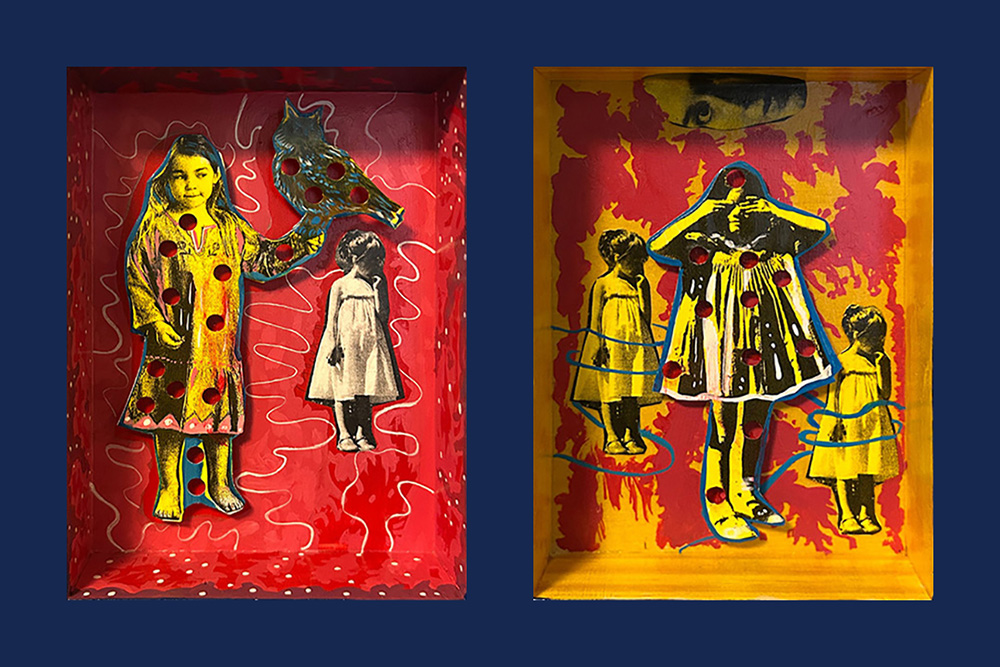
Camille Cunningham, Pray (left), Prey (right), 2026, Collage, Acrylic on Wood
In We the Other, Mack Farel transforms the familiar language and symbolism of American patriotism into a meditation on exclusion, belonging, and resilience. Constructed as a wearable brooch, the work adopts the visual form of a star—a symbol closely associated with national identity, civic pride, and collective ideals. Yet rather than affirming these associations, Farel disrupts them. Etched across a metal crossbar spanning the star is the phrase “WE THE OTHER,” a deliberate reworking of language traditionally used to invoke democratic unity. In this subtle shift, the work redirects attention toward those who have historically been excluded from the protections and promises of American freedom.
The brooch’s distressed surface reinforces this tension. Patina and wear suggest histories that have been neglected, obscured, or eroded over time, while the red, white, and blue stones embedded within the piece evoke national symbolism complicated by contradiction. Suspended beneath the star, a tassel composed of intertwined cords in the same colors extends the work’s visual language. Burned at its ends, the tassel introduces themes of violence, grief, and survival, transforming patriotic colors into traces of endurance rather than celebration.
By employing the format of adornment, Farel engages the social and political dimensions of what it means to wear an identity. Brooches have historically signified allegiance, honor, or affiliation; here, the object becomes a declaration of presence on behalf of those rendered “other” by systems of power. We the Other acknowledges histories of exclusion while refusing erasure, asserting that communities denied full recognition remain visible, resilient, and central to the ongoing struggle over who belongs within the nation’s collective narrative.
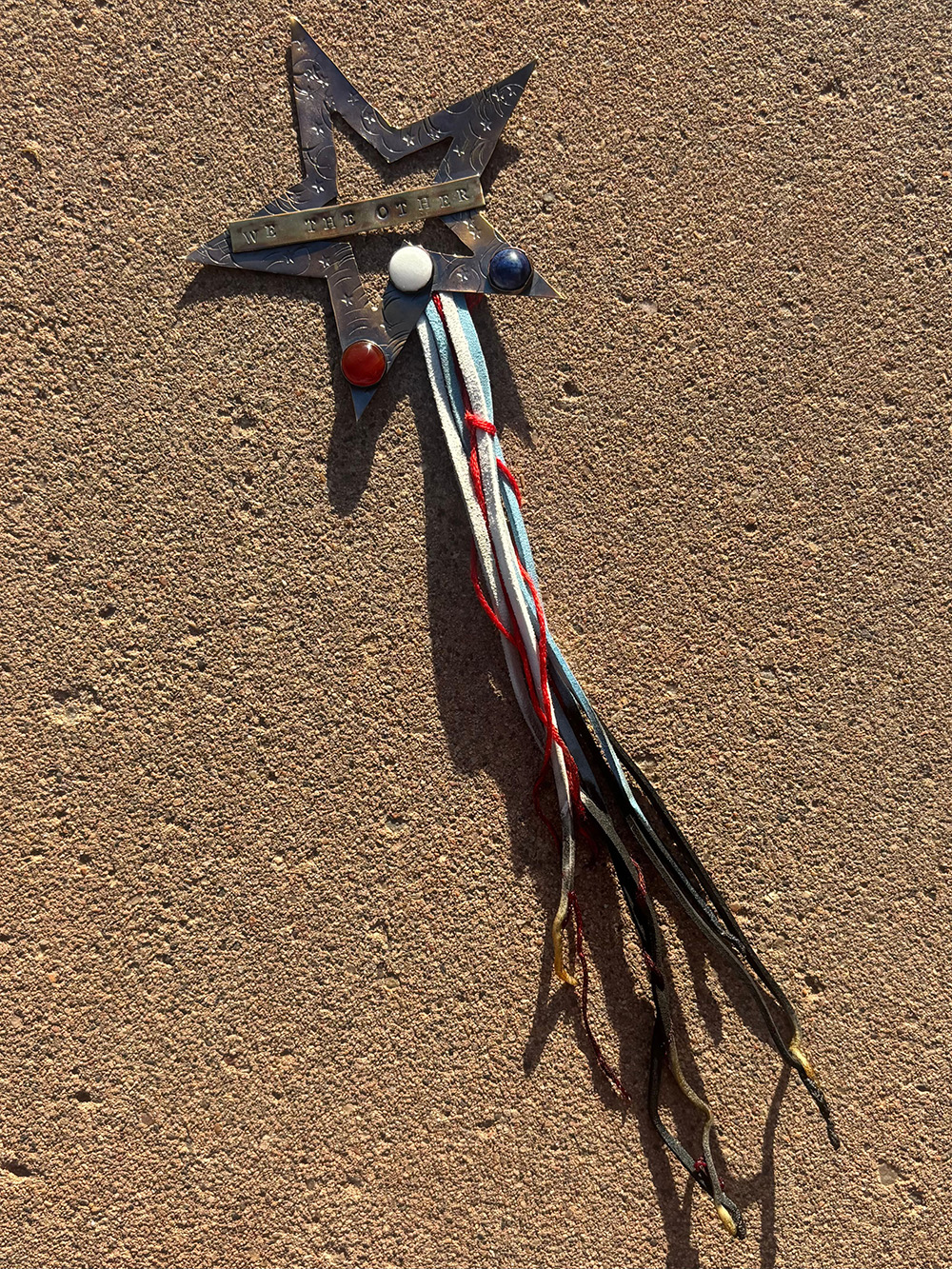
Mack Farel, We the Other, 2025, Brass, Ink, Stones, Leather Cord, Embroidery Thread
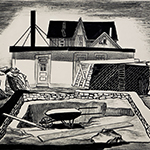
In Go Back Home (I Am Home?), Jocelyne Garcia Ortiz transforms a childhood memory into a powerful reflection on belonging, identity, and the persistence of anti-immigrant sentiment in the United States. Based on an incident from the artist’s youth, the painting recalls returning home to find the words “GO BACK HOME” spray-painted across her family’s garage door. Though the vandalism was quickly removed, the event remained largely unspoken, lingering as an unresolved memory whose significance became clearer with time. By revisiting this experience as an adult, Garcia Ortiz brings private trauma into public view, creating space for conversations that are often avoided or suppressed.
The painting depicts a modest suburban home rendered with careful realism, grounding the scene in the familiarity of everyday life. In contrast, the surrounding landscape is animated by expressive, turbulent brushwork. Trees, grass, and foliage dissolve into restless gestures, suggesting the instability of memory and the emotional residue of an event that continues to reverberate long after its physical traces have disappeared. The contrast between the solidity of the house and the agitation of its surroundings reflects the central contradiction embedded within the work: the experience of being treated as an outsider in the very place one calls home.
The painting’s title intensifies this tension. The phrase “Go Back Home” is answered by the questioning refrain “I Am Home?”, exposing the absurdity and violence of demands that equate belonging with race, language, or ancestry. Rather than depicting an isolated act of prejudice, Garcia Ortiz reveals how such moments participate in larger systems that define who is perceived as American and who remains subject to suspicion.
Created during a period of heightened political rhetoric surrounding immigration, the work continues to resonate in a climate where questions of citizenship, migration, and national identity remain deeply contested. Go Back Home (I Am Home?) challenges viewers to consider how exclusion operates not only through policy and law, but also through everyday acts that communicate who is welcomed, who is tolerated, and who is told they do not belong.
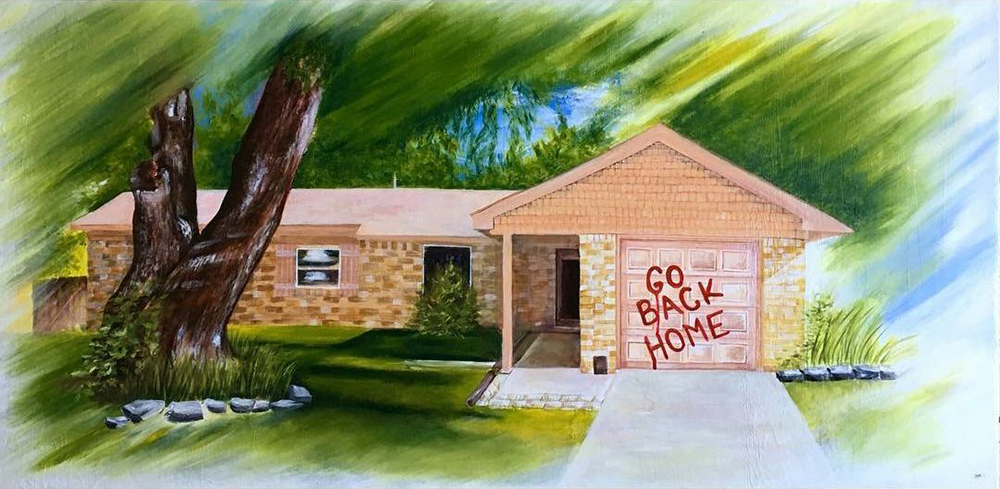
Jocelyne Garcia Ortiz, Go Back Home (I Am Home?), 2018, Acrylic on Canvas
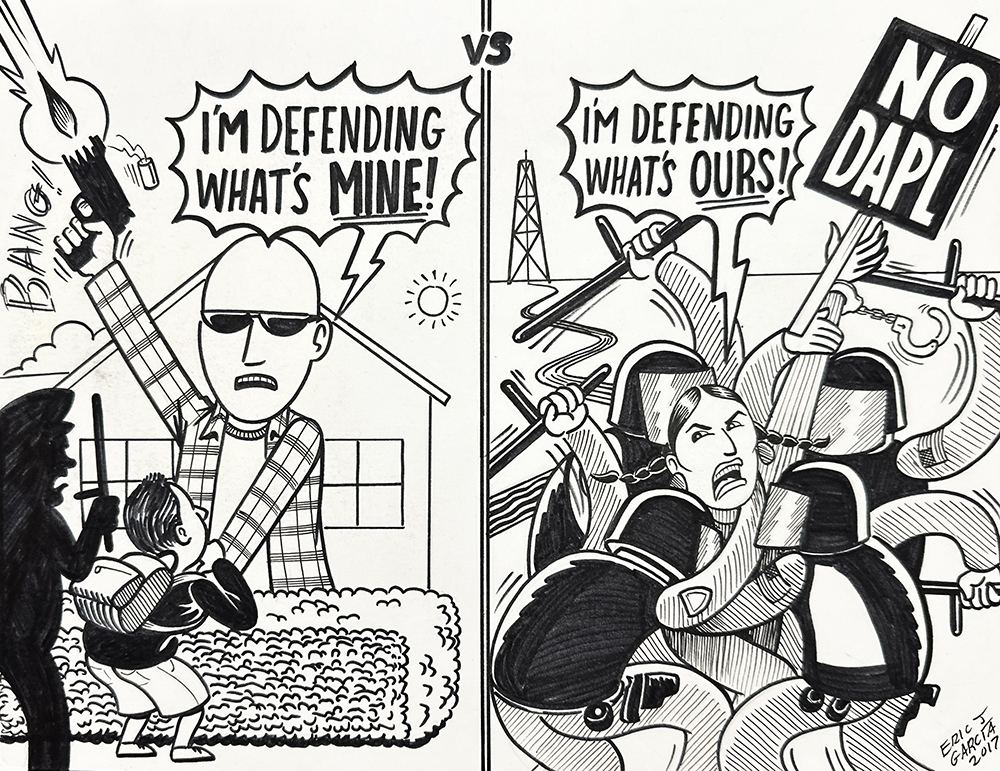
The work of Eric J. García confronts the narratives through which the United States understands itself, exposing the distance between national mythology and historical reality. Drawing from traditions of political cartooning, Mexican muralism, and Chicano social critique, García employs humor, satire, and graphic immediacy to challenge historical amnesia and the whitewashing of the past. His images are accessible and visually direct, yet beneath their bold surfaces lies a sustained examination of power, inequality, and the stories societies choose to celebrate or suppress.
The silkscreen print 4 Evils distills this approach into a potent allegory. Rendered in a stark palette of red, white, and black, the work depicts Uncle Sam transformed into a devilish figure whose pitchfork pierces an inflated globe. Each prong is labeled with a social ill—“Militarism,” “Racism,” “Poverty,” and “Pollution”—implicating these forces as foundational rather than accidental features of American power. By recasting one of the nation’s most recognizable patriotic symbols as a demonic agent, García subverts familiar iconography and asks viewers to reconsider what, precisely, is being celebrated in national commemorations.
A similar strategy animates Defending What’s Important. Divided into opposing scenes, the drawing contrasts two competing visions of rights, ownership, and public responsibility. On one side, a man invokes personal entitlement while excluding and threatening others; on the other, a protester defending collective resources faces state violence. The juxtaposition exposes how declarations of freedom can function differently depending on who is speaking, whose interests are being protected, and who bears the consequences.
Across both works, García demonstrates how visual satire can reveal uncomfortable truths. Rather than offering simple condemnation, he encourages critical engagement with the structures that shape public life. His art insists that history is neither fixed nor neutral, but actively constructed through symbols, stories, and acts of remembrance. In doing so, García transforms political critique into a call for greater accountability, historical awareness, and a more just future.
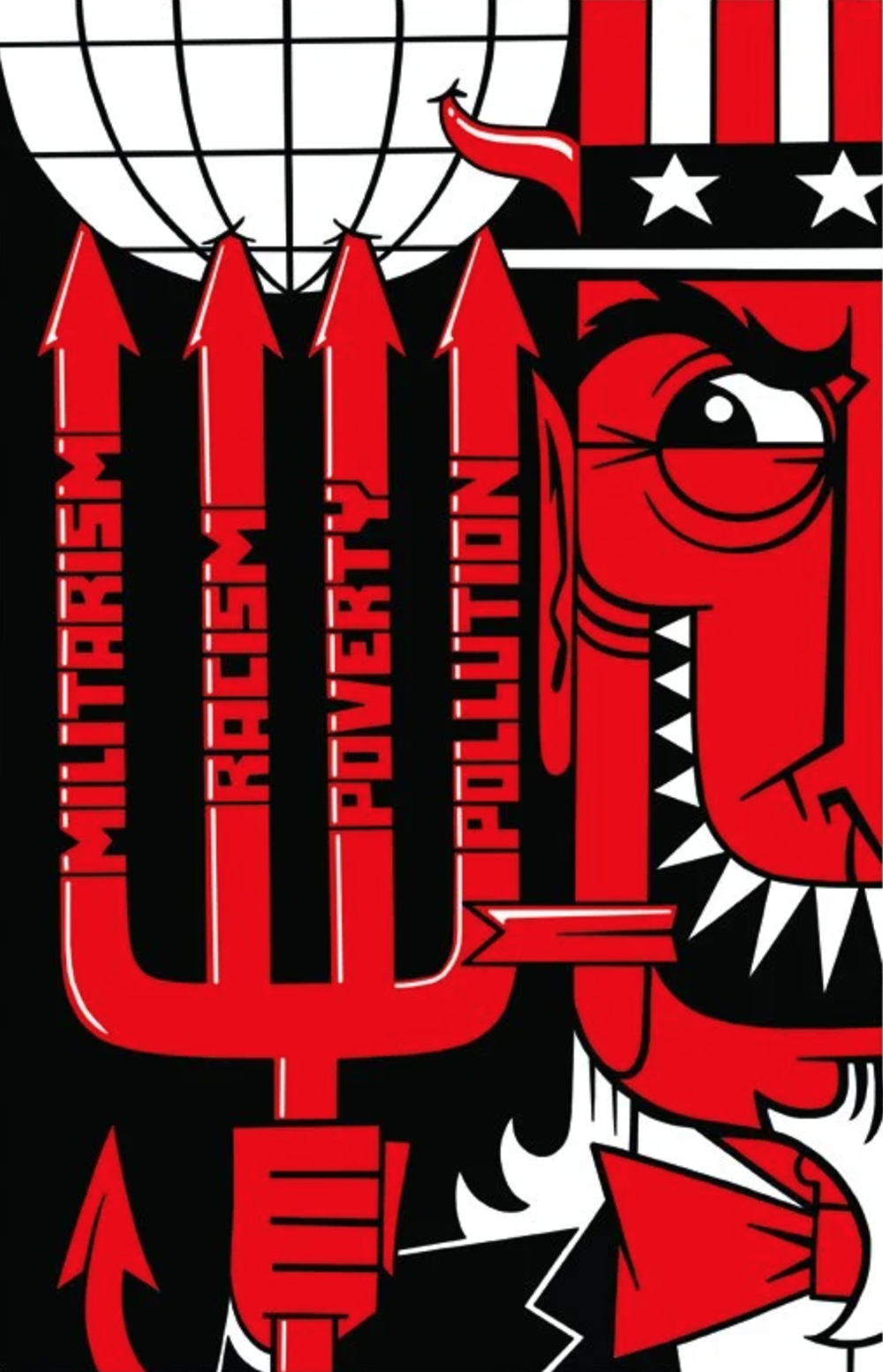
Eric J. García, 4 Evils, 2021, Serigraph on Paper
Bill of Rights, by Mikaela Guggino, reimagines one of the foundational documents of American democracy through the visual language of the illuminated manuscript. Drawing upon a tradition historically associated with religious devotion, political authority, and the preservation of cultural values, Guggino transforms the first ten amendments into an object of contemplation, asking viewers to consider the distance between the rights enshrined in law and their realization in everyday life.
Rendered in acrylic and ink, the work features the text of the Bill of Rights framed within an elaborate gold lattice reminiscent of stained-glass windows and medieval manuscript ornamentation. Flowers emerge through the geometric structure, some flourishing while others wilt, creating a visual metaphor for the health of the principles the document represents. At the center of the composition, an anatomical heart partially obscures the text, positioning the Bill of Rights not merely as a legal framework but as the lifeblood of the American promise. The heart suggests that these protections remain vital and living, sustained only through collective care, vigilance, and participation.
The choice of the illuminated manuscript form is particularly significant. Historically used to preserve sacred texts and reinforce institutional authority, the manuscript carries an aura of reverence and permanence. Guggino appropriates this tradition to elevate constitutional rights to a similar status while simultaneously questioning whether contemporary society honors them in practice. The work suggests that rights are not self-sustaining; they can flourish or wither depending on how they are interpreted, defended, and extended.
Balancing beauty with critique, Bill of Rights reflects the artist’s belief that art can serve as both reflection and action. Rather than abandoning the ideals embedded within the nation’s founding documents, Guggino calls for renewed commitment to them. Her work asks viewers to look beyond political rhetoric and consider what it would mean to uphold principles of equality, liberty, and human dignity not as aspirations, but as lived realities.
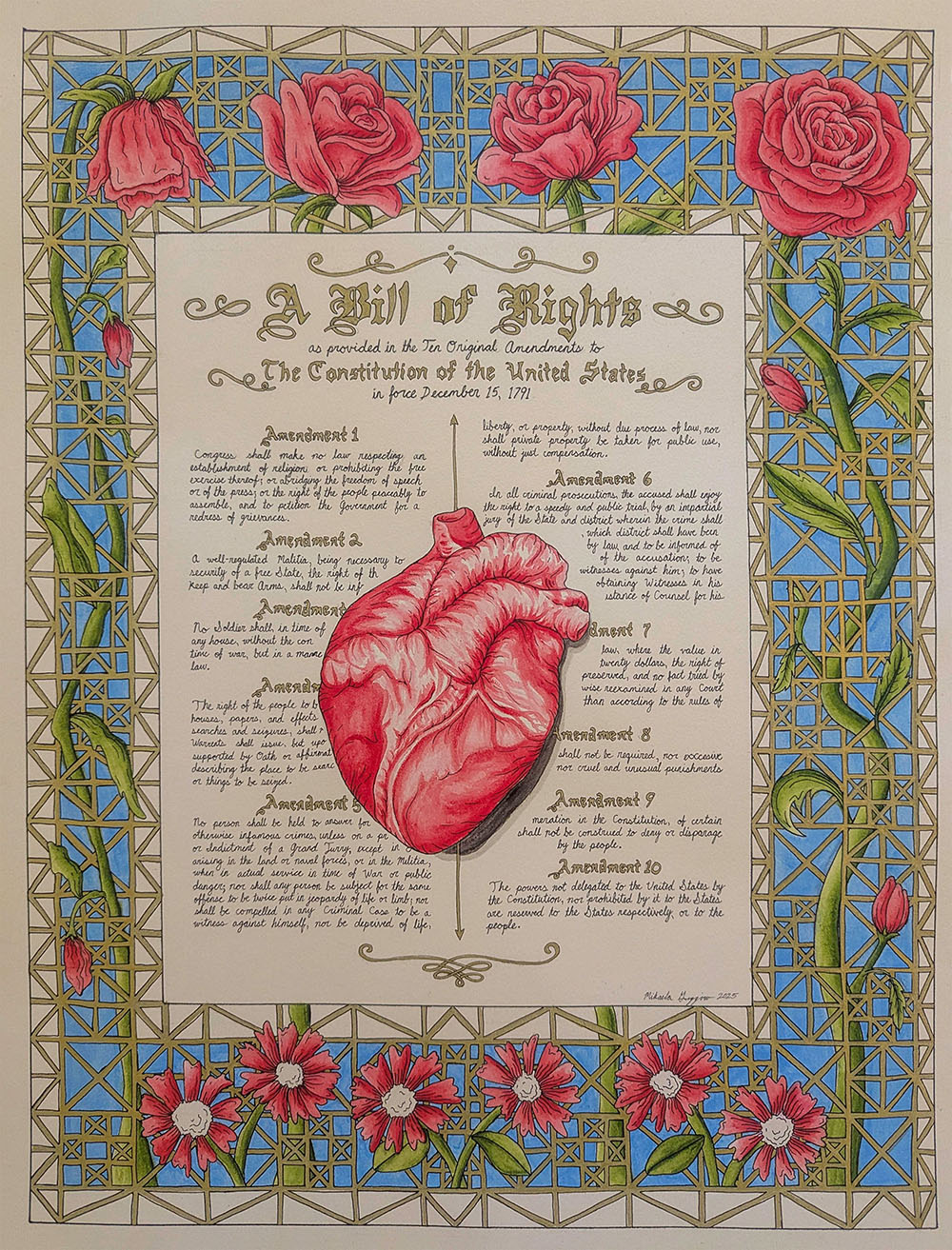
Mikaela Guggino, Bill of Rights, 2025, Acrylic, Ink on Paper
In Father’s Day performance with yucca flowers, Rica Maestas draws upon ritual, embodiment, and place to explore the enduring legacies of colonialism in the Southwest. Documented through a cross-shaped arrangement of photographs, the work reimagines a historical practice associated with the aftermath of the Pueblo Revolt of 1680, when Pueblo peoples sought to cleanse themselves of Spanish influence following their successful resistance to colonial rule. Rather than presenting history as a distant event, Maestas activates it as a living framework through which contemporary systems of power can be understood and challenged.
The photographs document a solitary performance staged along a riverbank. A nude figure washes her hair and body with yucca flowers, a plant long associated with cleansing and survival in the desert landscape. Throughout the sequence, her face remains obscured by wet hair, shifting attention away from individual identity and toward the symbolic dimensions of the action itself. The repeated gestures of washing suggest both purification and release, transforming the body into a site where historical memory, cultural inheritance, and personal experience converge.
The work’s cross-shaped arrangement is particularly significant. While it echoes Christian iconography introduced through colonization, Maestas reclaims the form through an act of renewal rather than submission. The central image, in which a dish of yucca flowers is held above the river’s water, functions as an offering and a point of transformation from which the surrounding actions unfold.
Created in 2020 amid the overlapping crises of the COVID-19 pandemic and widespread protests against racial injustice, the performance resonates beyond its historical reference. Maestas connects colonial violence to contemporary systems of domination, inviting viewers to consider what inherited structures continue to shape bodies, identities, and daily life. At the same time, the work is grounded in care rather than despair. Through ritual, landscape, and the wisdom of desert plants, Father’s Day performance with yucca flowers imagines cleansing not as forgetting, but as an ongoing practice of healing, resistance, and becoming otherwise.
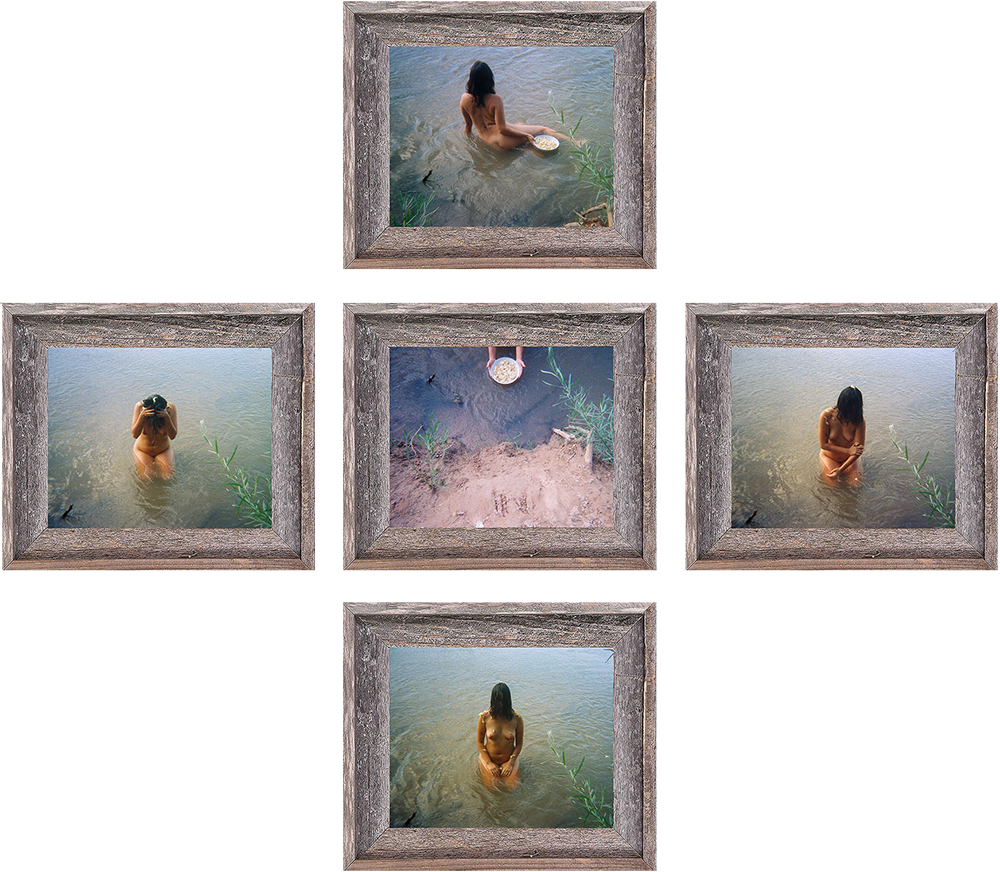
Rica Maestas, Father's Day performance with yucca flowers, 2020, Performance Documentation on Framed Kodak Pearl Prints
King Baby, by Jessica Metz, examines the instability of national symbols and the values they are made to represent. Working at the intersection of art, architecture, and social critique, Metz investigates how systems of power shape both physical and psychological landscapes. In this work, she turns her attention to one of the most recognizable symbols of American identity: the flag.
Suspended from an eagle-topped flagpole, an American flag hangs upside down and is entirely covered in gold leaf. Across its surface, the phrases “ALL HAIL” on one side and “KING BABY” on the other are spray-painted in black. The work immediately transforms a familiar emblem of democratic ideals into something more troubling. The upside-down flag, traditionally reserved as a signal of distress, suggests a nation in crisis. Yet the addition of gold leaf complicates that message. The flag appears simultaneously precious and corrupted, cloaked in the language of wealth, spectacle, and self-aggrandizement.
The title sharpens the work’s critique. King Baby evokes a figure defined by entitlement, immaturity, and an expectation of unquestioned obedience. Combined with the command “ALL HAIL,” the piece suggests a political culture increasingly organized around personality, grievance, and displays of power rather than collective responsibility. By replacing the language of citizenship with the language of monarchy, Metz exposes tensions between democratic ideals and authoritarian impulses.
Rather than treating the flag as a fixed symbol, King Baby emphasizes that national icons derive their meaning from the values and actions of the societies that animate them. The work asks viewers to consider whether contemporary political realities align with the principles the flag is commonly said to represent. In doing so, Metz transforms a patriotic object into a mirror, reflecting back questions about power, accountability, and the distance between national mythology and lived experience. The result is both an indictment and a challenge: if symbols ultimately mean what we make them mean, what exactly are we pledging allegiance to?
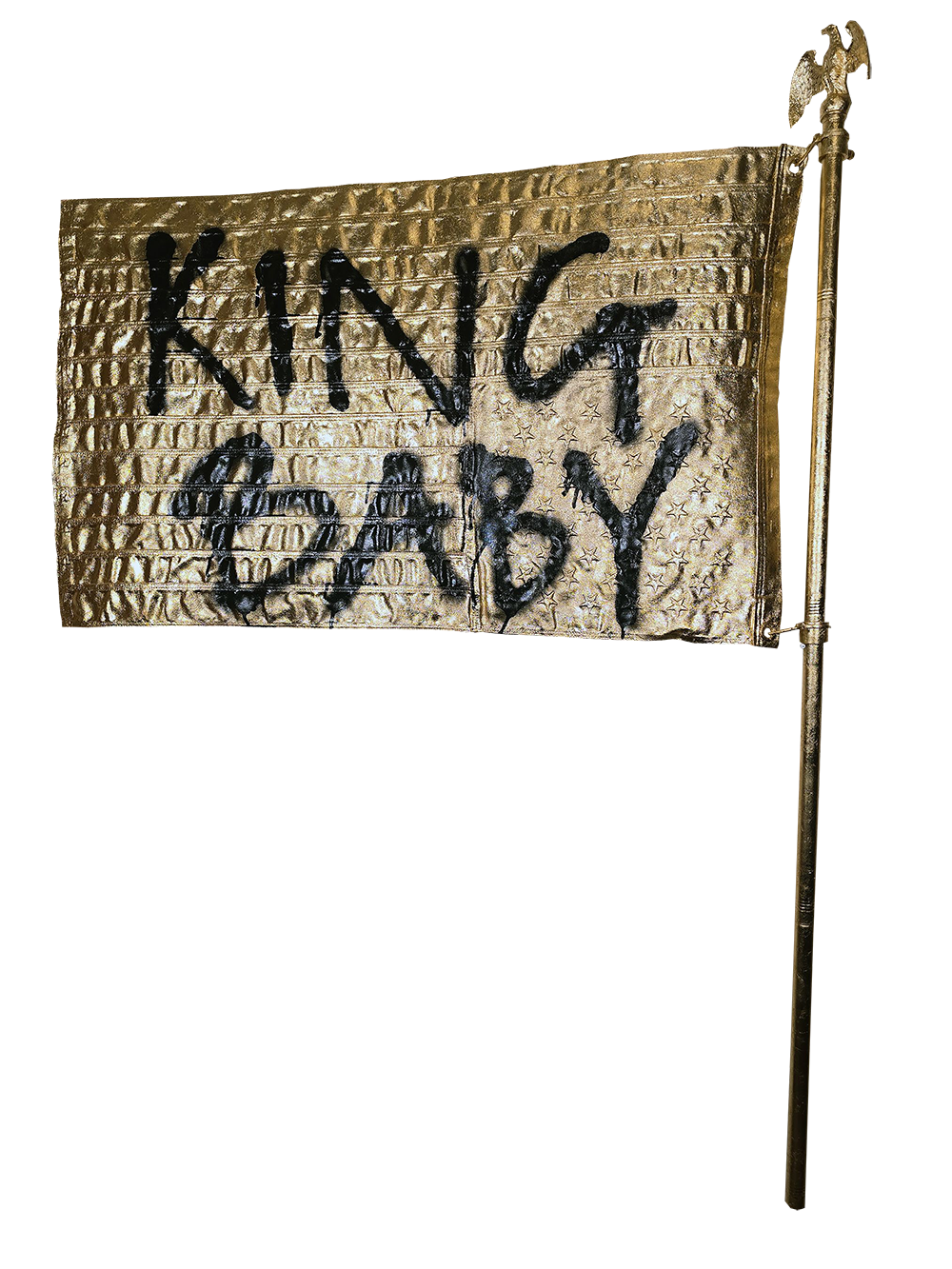
Jessica Metz, King Baby, 2025, American Flag, Eagle-Capped Flag Pole, Gold Leaf, Spray Paint
In Patriotic Napkins, Ashley Miller stages a quiet but unsettling investigation into the collision between national symbolism, consumer culture, and the inherited narratives that structure American identity. Presented as a carefully composed still life, the photograph transforms an everyday disposable object into the central subject of sustained attention, asking what happens when the iconography of patriotism is absorbed into systems of consumption and discard.
At the center of the composition, a crumpled American flag napkin lies stained on a weathered wooden table. The ambiguity of the mark—suggestive of food, wine, or blood—introduces a deliberate instability, where celebration and violence become difficult to separate. Behind it, a heavy, luxurious curtain drapes into the frame, evoking the visual language of historical still life painting, where textiles and objects signified wealth, trade, and cultural status. This juxtaposition between the ornate and the disposable establishes a tension between permanence and ephemerality, value and waste.
Miller’s use of the still life tradition is critical to the work’s structure. Historically, still life painting elevated ordinary objects into carriers of moral, political, and philosophical meaning, often through references to mortality and impermanence. Patriotic Napkins echoes this lineage through its own vanitas-like sensibility: the crumpled napkin becomes a contemporary emblem of consumption’s aftermath, where meaning is both produced and exhausted through use.
The presence of the American flag as a mass-produced, disposable object complicates its status as a protected national symbol. Rather than appearing as an object of reverence or ceremony, it is rendered functional, used and discarded. This shift raises questions about how patriotism is performed in everyday life and how national identity is circulated through consumer goods that both affirm and undermine their own symbolism.
Within the broader context of the exhibition, Miller’s photograph extends the inquiry into the gap between declaration and practice by focusing on the mundane surfaces where ideology is quietly reproduced. In the staging of this still life, the work suggests that national meaning is not only declared in foundational documents or public rituals, but also constructed—and potentially undone—through the ordinary, overlooked acts of daily consumption.
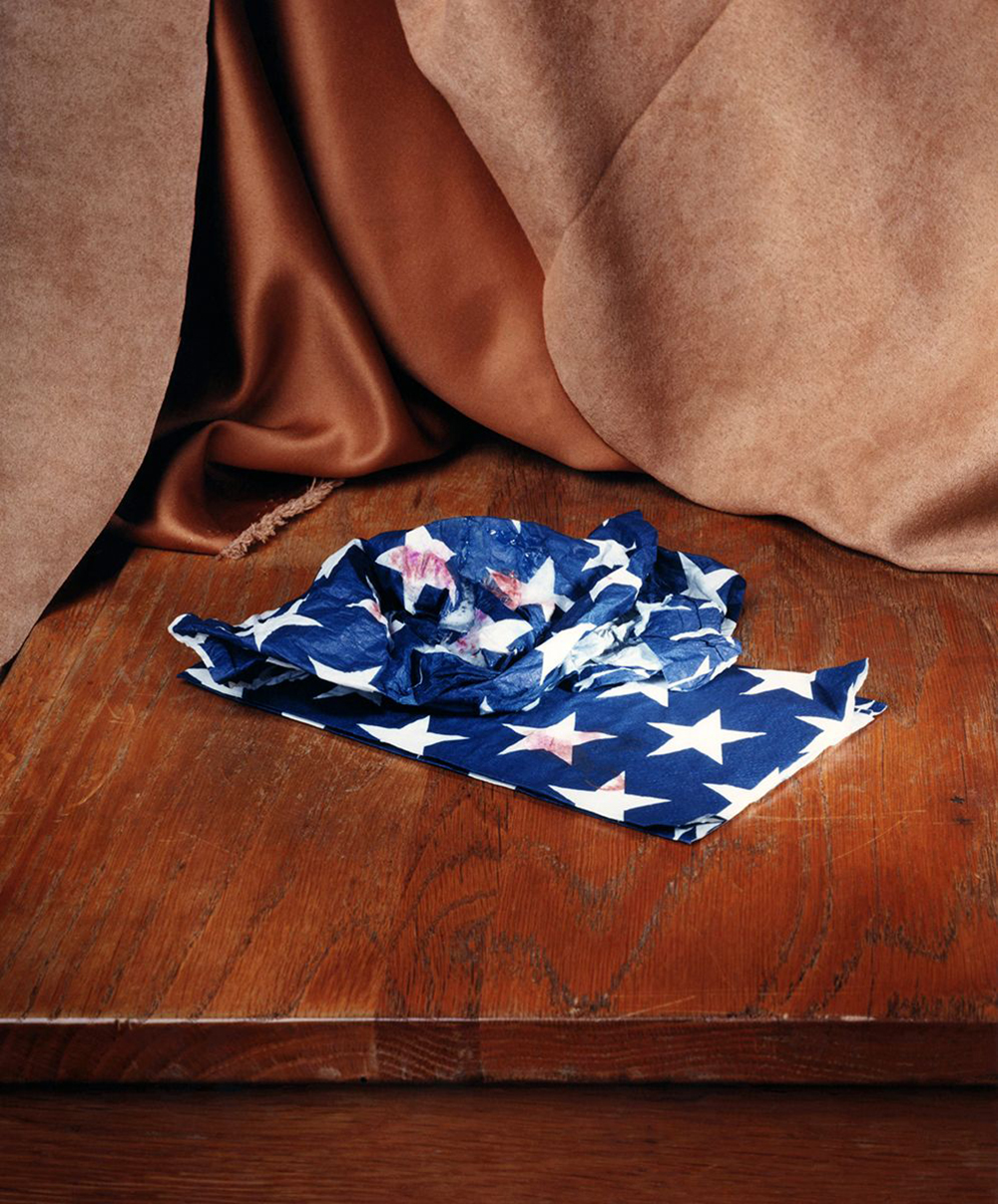
Ashley Miller, Patriotic Napkins, 2024, 2017, C-Print
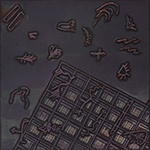
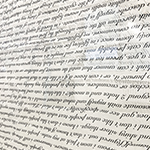
Legibility, by Brooke Redux, engages the authority of foundational political texts through the destabilizing language of asemic writing. Constructed from vitrigraphy—molten glass drawn into calligraphic lines—the work resembles cursive script while resisting any attempt at reading. Installed as five horizontal bands suspended from a wall-mounted bracket, the composition evokes the structure of a written page, yet withholds the clarity of language. Instead of conveying a message, it stages the act of interpretation itself as its primary subject.
From a distance, the work appears readable, recalling the visual familiarity of handwritten documents or institutional records. As viewers approach, however, that expectation dissolves. What initially seemed like text dissolves into illegible, fragile glass forms. This shift produces a moment of cognitive dissonance: the viewer is confronted not with meaning, but with the expectation of meaning. In this way, Legibility mirrors the experience of encountering monumental political documents whose language is often treated as transparent, authoritative, and self-evident, yet which remain open to interpretation, contradiction, and omission.
Redux’s use of glass intensifies this tension. The material’s fragility and translucency introduce a sense of precariousness, while the shadows cast by the installation extend the illusion of writing onto the surrounding wall. Meaning appears both present and displaced, tangible and inaccessible. The work thus occupies an unstable space between communication and abstraction, inviting viewers to consider how authority is constructed through form as much as content.
Within the context of Declarations of Incongruence, Legibility reflects on how national identity is shaped not only by what texts declare, but by how those declarations are read, repeated, and misunderstood over time. By stripping writing of semantic certainty while preserving its visual structure, Redux foregrounds the desire for clarity that underlies encounters with law, history, and ideology. The work suggests that meaning is not simply contained within texts, but produced through the act of trying—and failing—to fully read them.
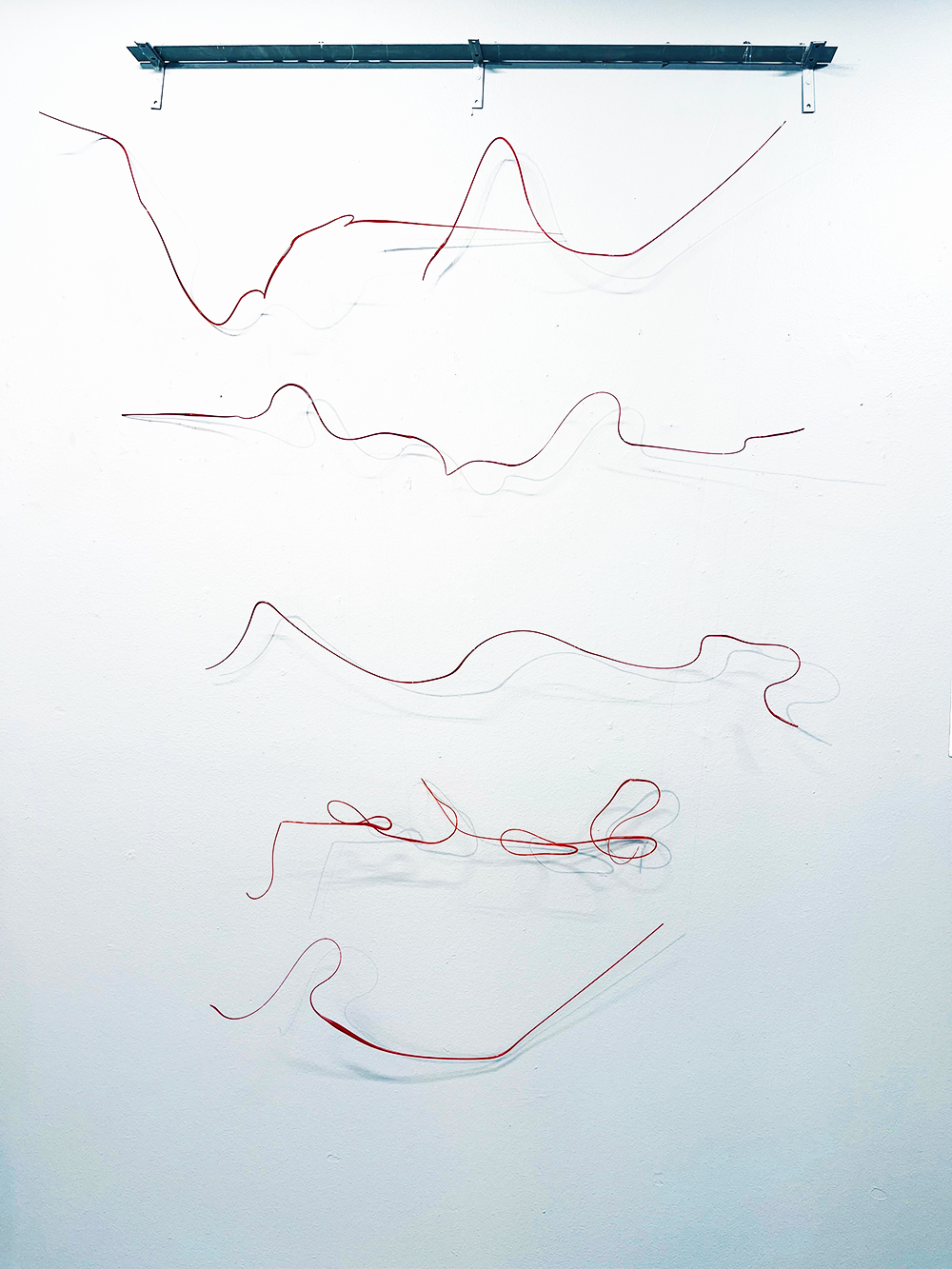
Brooke Redux, Legibility, 2026, Glass Vitrigraph
In TRUST, Masha Sha approaches language as both material and unstable structure, where meaning is continuously made, disrupted, and reassembled. Created through dense accumulations of graphite marks on tracing paper, the work forms the word “trust” in large-scale fragments that remain legible yet visibly unsettled. Split horizontally and slightly misaligned across two adjoining sheets, the word persists while its internal coherence falters, producing a subtle but sustained perceptual and conceptual tension.
From a distance, TRUST appears whole. The viewer recognizes the word immediately, drawn into its apparent clarity. As the viewer moves closer, however, the fracture becomes evident: the upper and lower halves no longer align precisely, and the surrounding field of repetitive mark-making begins to dominate perception. The word is still present, but its stability is compromised. This condition of near-coherence evokes the fragile structures through which trust itself operates—systems that rely on alignment between expectation and behavior, appearance and reality, promise and fulfillment.
Sha’s process emphasizes accumulation and repetition, where thousands of small gestures gradually produce both form and disruption. The word emerges not through direct inscription, but through negative space carved out of dense fields of mark-making. In this sense, language is not simply written but excavated, revealed through absence as much as presence. The resulting image holds a paradox at its core: meaning is simultaneously constructed and destabilized through the very act of making it visible.
Within the context of Declarations of Incongruence, TRUST resonates as a reflection on the conditions under which collective, institutional, and interpersonal trust is sustained or eroded. The slight misalignment at the center of the work suggests not collapse but strain—a system still readable, still functioning, yet no longer fully secure in its correspondence. In this way, Sha’s drawing holds space for ambiguity, where trust is neither affirmed nor denied, but shown as something continually negotiated, dependent on fragile alignments that can never be fully guaranteed.
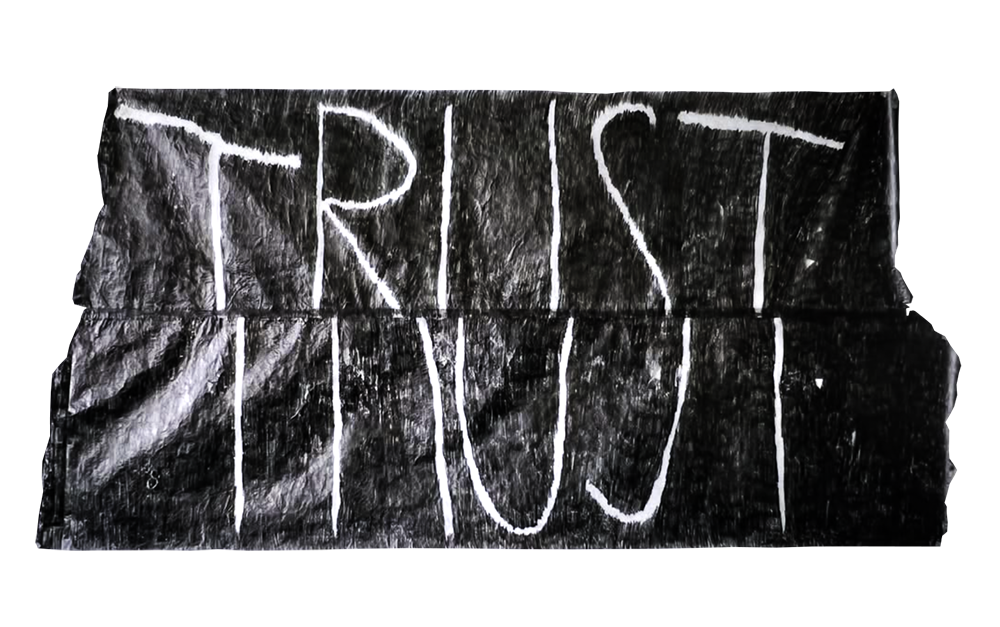
Masha Sha, TRUST, 2021, Graphite on Tracing Paper
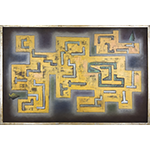
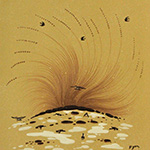
Exclusion Zone, by Chandler Wigton, emerges from a practice that moves fluidly between drawing, collage, and painting, using systems of mapping, abstraction, and material accumulation to explore how landscapes—both physical and conceptual—are shaped by structures of knowledge and power. The work reflects on the instability of perception itself, where images form and dissolve like mirages, and where meaning is perpetually approached but never fully secured.
At the center of the composition is a dense, irregular cluster of yellow and green forms derived from found census maps of the United States. By removing place names and retaining only county divisions, Wigton abstracts the administrative grid of the nation into a shifting, almost topographical mass. The resulting form hovers between several readings: a distorted map, an inverted globe, or a compressed field of bodies and territories. This ambiguity underscores how systems of classification—geographic, demographic, or political—both organize and obscure the realities they attempt to describe.
Radiating outward from this central form are blue linear gestures that suggest waves, vibrations, or unseen forces extending through space. Set against a field of red oval impressions created through graphite rubbings, the surface evokes layered systems of infrastructure, data, or containment. The interplay between these elements produces a sense of circulation and restriction at once, where movement is implied but continually redirected.
The title Exclusion Zone situates the work within both literal and symbolic registers. Referencing areas restricted due to military activity, environmental disaster, or political control, the term evokes spaces defined by absence, danger, and regulation. In Wigton’s interpretation, this notion expands beyond geography into a broader reflection on contemporary life, where inclusion and exclusion are continually negotiated through policy, history, and cultural narrative.
Made while the artist was in proximity to the Trinity Test Site in New Mexico, the work carries an additional layer of historical resonance, linking localized landscapes to global systems of nuclear power and its enduring consequences. Within the context of Declarations of Incongruence, Exclusion Zone situates the United States itself as a contested space—one shaped by overlapping histories of control, erasure, and resistance. At the same time, the work holds open the possibility of interpretation, inviting viewers to navigate its shifting forms as unstable but meaningful terrains.
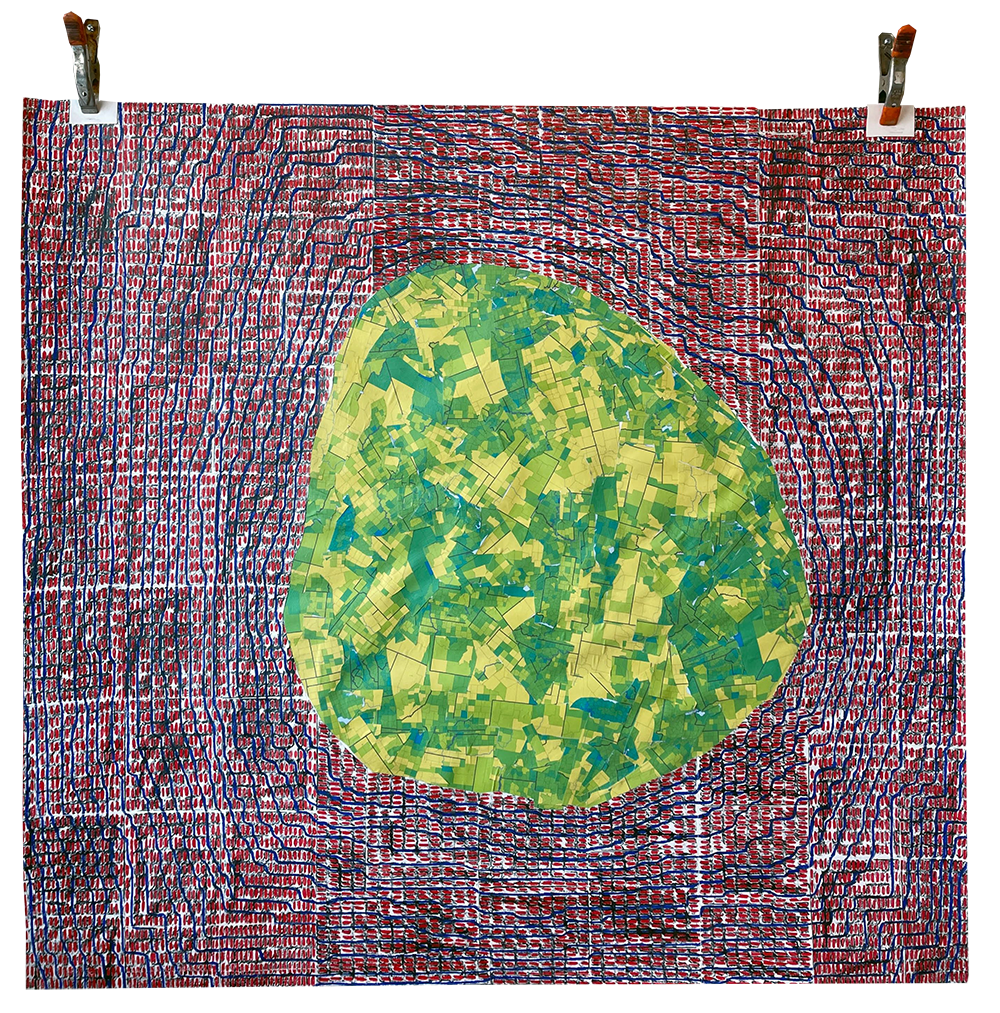
Chandler Wigton, Exclusion Zone, 2026, Collage, Graphite, Colored Pencil on Paper
Shut Up and Enjoy the Fireworks, by Aaron Wilder, operates as a counter-commemorative video work that interrogates how national identity is constructed through repetition, spectacle, and political language. Structured around layered bursts of hyper-saturated fireworks footage, the piece initially presents an image of celebration: dense, accelerated color radiating outward in all directions, beginning and ending in a field of black. Yet this visual excess is continually interrupted by whispered fragments of political speech and the escalating sounds of gunfire and explosions, destabilizing the boundary between celebration, violence, and rhetoric.
The work draws from contemporary political discourse, including excerpts from Executive Order 14253 (“Restoring Truth and Sanity to American History”) and a wide array of slogans, claims, and rhetorical phrases associated with presidential address. Rendered as whispered audio fragments, these statements circulate beneath and between the visual rhythm of fireworks, producing a tension between spectacle and language. The result is not a linear argument but an immersive environment in which meaning accumulates through repetition, interruption, and collision.
Wilder’s practice often engages the construction of social narratives through institutional language and mediated experience. In this work, fireworks—traditionally associated with national celebration and collective memory—become inseparable from the sonic presence of conflict and ideological assertion. The overlay of celebratory imagery with militarized sound collapses distinctions between festivity and force, suggesting how public rituals of national identity are entangled with mechanisms of power.
By framing the work as a “counter-commemoration,” Wilder shifts attention away from a singular narrative of national celebration and toward the contested processes through which history is narrated, revised, and performed. The piece reflects on how official language and cultural spectacle jointly shape perceptions of belonging, authority, and collective memory. Rather than offering resolution, Shut Up and Enjoy the Fireworks sustains a state of perceptual and conceptual instability, asking viewers to inhabit the uneasy space between celebration and critique, visibility and noise, history and its ongoing reinterpretation.
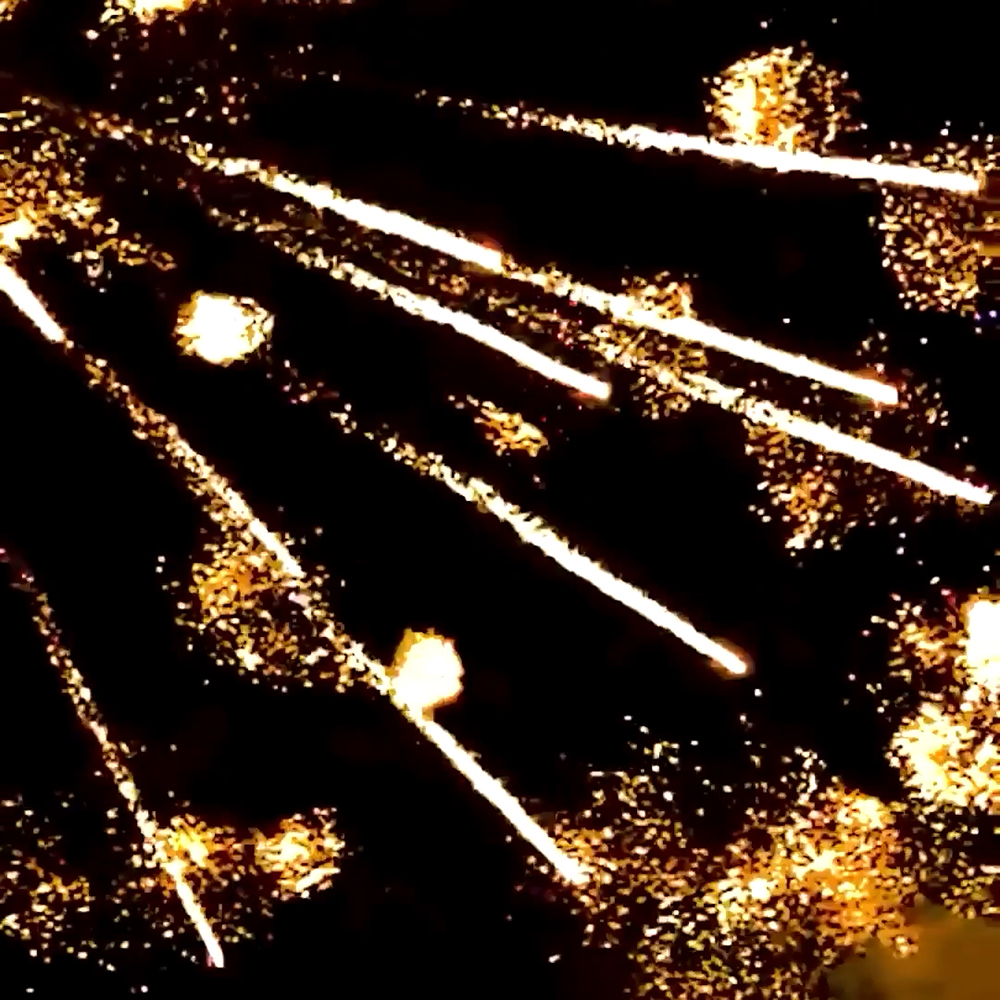
Aaron Wilder, Shut Up and Enjoy the Fireworks, 2026, Digital Video with Sound
Despite hypocritical claims of progress toward true equality, fairness, and justice over the past 250 years, our present reflects a different reality. The independence and powers of the legislature and judiciary have largely been ceded to the executive who denies the lived experiences and rights of those with identities he deems improper; enters into foreign wars without announcement or justification; forfeits the fragile ecological commons to corporate exploitation; gaslights the public by declaring the undoing of political ideology while denying his own active political ideology; militarizes the streets of cities where people demonstrate opposition to his policies and actions; persecutes human beings without cause or due process; and silences dissent, particularly the voices of those who advocate for communities he oppresses. As written in the 2025 executive order 14253: “These are just a few examples.”
By engaging with the Declaration of Independence not as a static historical document but as a living framework of promises, exclusions, and contested freedoms, Declarations of Incongruence invites viewers to confront the continuities of injustice and the ongoing work of independence. The exhibition foregrounds critique, highlighting the ways artists refuse inherited narratives. It is an invitation to reckon with the legacies we inherit, to acknowledge the freedoms still denied, and to imagine what a more just, inclusive, and accountable society could yet become. Independence, if it is to mean anything now, must be practiced, not commemorated. The contradictions remain. Whether we do is the question.


.jpg)