by Aaron Wilder, Curator of Collections and Exhibitions at the Roswell Museum
Roswell Daily Record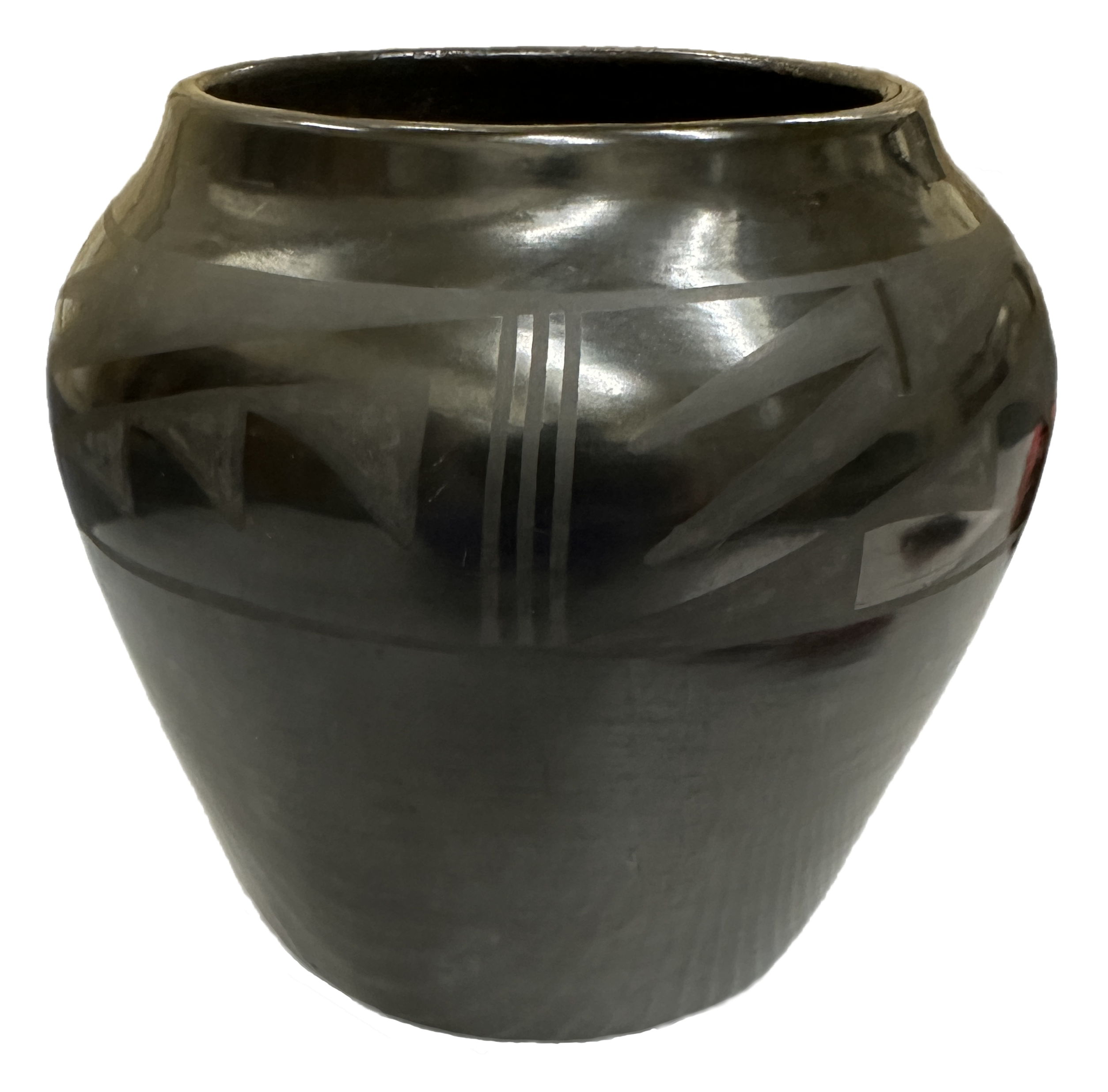
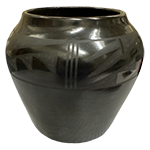
“San Ildefonso Jar” by Maria Martinez, Circa 1926-1934, Black Earthenware, Acquisitions Fund Purchase, 1985.011.0001
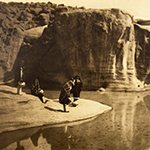
Maria Martinez remains the single most cited and influential ceramicist associated with Indigenous pottery of the broader American Southwest region. The artist was born circa 1887 as Maria Antonia Montoya (Po’ve’ka in the Tewa language) on the San Ildefonso Pueblo (in the Tewa language its name is Po-woh-ge-oweenge, meaning “where the water cuts through”), which is located 20 miles northwest of Santa Fe. The Pueblo is known to have been inhabited since 1300 CE as a Tewa-speaking culture on the Pajarito Plateau. The surname Martinez came in 1904 when she married her husband Julian, who became her artistic collaborator in addition to spouse.
Maria Martinez first learned to make ceramic vessels by watching her maternal aunt, Nicolasa Peña, and her grandmother, Martina Montoya as they created pottery for the functional purposes of ceremonial use, cooking, and storage. She also learned from ceramicists from other, nearby communities, including Margaret Tafoya from the Santa Clara pueblo. In a 2015 Smarthistory essay, Dr. Suzanne Newman Fricke, art historian specializing in Native American art, explains the historical context in which Martinez started her ceramics practice by saying, “Before the arrival of the railroad to the area in the 1880s, pots were used in the Pueblos for food storage, cooking, and ceremonies. But with inexpensive pots appearing along the rail line, these practices were in decline.” Before creating the black-on-black pottery for which she would become known, Martinez collaborated with Julian on polychrome pottery up to approximately 1930.
Martinez’s celebrated black-on-black pottery emerged from a combination of archaeological inspiration, Pueblo ceramic traditions, and sustained experimentation. In the early twentieth century, excavations of ancestral Pueblo sites near San Ildefonso brought ancient ceramic fragments to light. While Edgar Lee Hewitt, then director of the Museum of New Mexico, encouraged Maria to study and recreate pottery inspired by these archaeological finds, the development of blackware ultimately depended on the Martinezes’ own ingenuity and years of hands-on research rather than simple reproduction.
The Martinezes’ experimentation intensified during the 1910s and culminated around 1919, when they successfully perfected the black-on-black technique. Both worked closely with ancestral designs uncovered at what is now Bandelier National Monument, where Julian assisted archaeologists and carefully sketched motifs found on pottery fragments and murals. These designs, drawn from Pueblo visual language rather than copied directly, later appeared on their vessels. Their innovation lay not only in design but also in process. Martinez formed pots by hand using locally sourced clay mixed with temper made from crushed sherds or volcanic ash, shaping the vessels with coil techniques rather than a potter’s wheel. Once formed, the surfaces were smoothed, scraped, sanded, and carefully burnished with stone, a labor-intensive step crucial to achieving the glossy finish characteristic of blackware.
The dramatic contrast between matte and polished surfaces resulted from both surface treatment and firing methods. Over the burnished slip, designs were painted using an iron-rich solution derived from mineral sources or plants such as guaco. During firing, the pottery was stacked outdoors and surrounded by wood and dried cow manure. At peak heat, the fire was smothered, creating a smoke-filled, low-oxygen (reducing) atmosphere that transformed the red clay into black. The polished areas turned glossy, while the painted designs remained matte, producing subtle visual contrasts. Although these vessels were less watertight and not intended for daily use, their aesthetic qualities appealed to a growing market for decorative art. The motifs, rain clouds, feathers, water serpents (avanyu), corn rows, and flowing rivers, reflected Pueblo relationships to land, water, and natural cycles. Throughout the process, Tewa prayers accompanied the gathering of clay and the firing of pots, underscoring the spiritual and communal foundations of Martinez’s work.
Martinez was asked to demonstrate her practice at several expositions, including the 1904 St. Louis World’s Fair, the 1914 Panama-California Exposition in San Diego, and the 1934 Chicago World’s Fair. Upon Julian’s death in 1943, Martinez continued her work, collaborating with other family members. Newman Fricke explains, “Ms. Martinez would form the perfectly symmetrical vessels by hand and leave the decorating to others. Throughout her career, she worked with different family members, including her husband Julian, her son Adam and his wife Santana, and her son Popovi Da. As the pots moved into a fine art market, Ms. Martinez was encouraged to sign her name on the bottom of her pots. Although this denied the communal nature of the art, she began to do so as it resulted in more money per pot.” Popovi Da’s collaboration was crucial in what would become his mother’s global fame. He built a shop at the Pueblo, marketed his mother’s work, and presented her innovations at lectures across the US.
Martinez sold her work at the Palace of the Governors and the Santa Fe Indian Market. During her lifetime, she was awarded the Craftsmanship Medal by the American Institute of Architects, the Ordre des Palmes Academique by the French government, and a grant to fund a pottery workshop in 1973 by the National Endowment for the Arts. One year after her death, Martinez was awarded the National Endowment for the Arts’ National Folk Heritage Fellowship in 1981. Individuals who collected her work include Ansel Adams and members of the John D. Rockefeller Jr. family. Martinez’s definitive legacy is the broader re-understanding of Native American pottery as fine art. In addition to the Roswell Museum, Martinez’s work can be found in the collections of the Metropolitan Museum of Art, the Museum of Modern Art, the National Museum of the American Indian, and the Smithsonian American Art Museum.
The statement “It’s Your Art” is meant to emphasize that the Roswell Museum’s collection is your collection. Despite the museum’s closure due to the October 2024 flood, staff continue to work behind the scenes on care for and conservation of collection objects. Please stay tuned for more from the Roswell Museum. We appreciate the outpouring of support from the community during our closure. And remember, “It’s Your Art.”