
by Aaron Wilder, Curator of Collections and Exhibitions at the Roswell Museum
Roswell Daily Record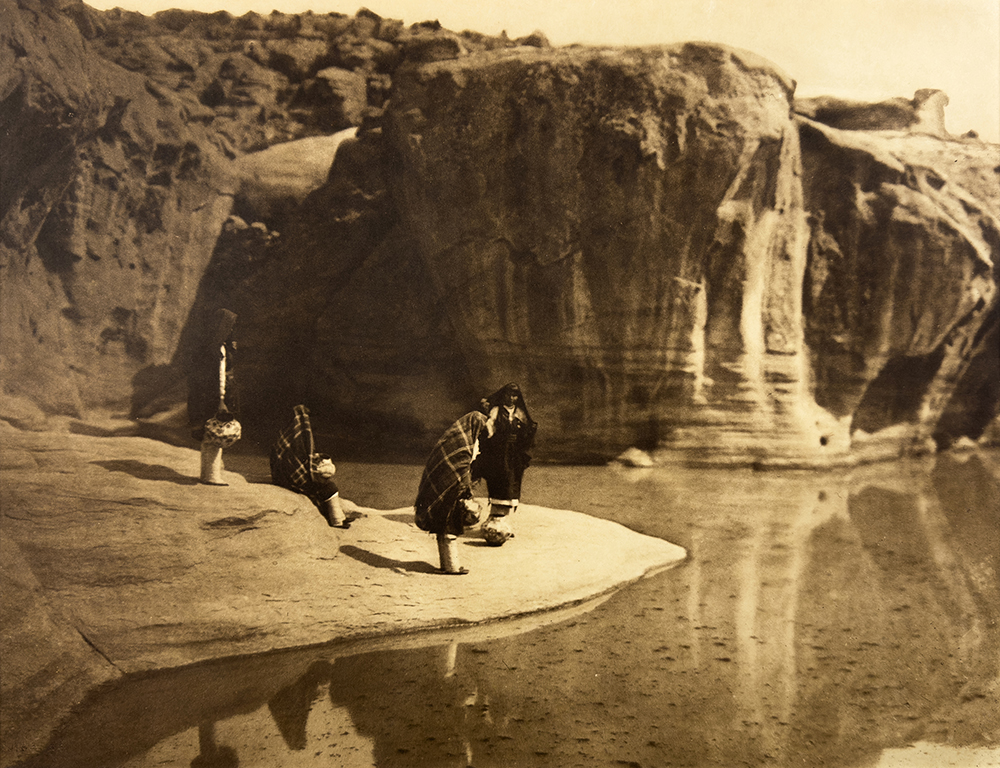
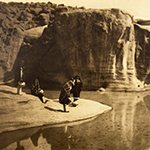
“Acoma Water Carriers” by Edward Sheriff Curtis, 1904, Photogravure on Japanese Vellum Paper, Acquisitions Fund Purchase, 1988.004.0001
Photographer Edward Sheriff Curtis set out to preserve what he believed was a disappearing world. About the project to which he devoted his entire professional life, he said “While primarily a photographer, I do not see or think photographically. Hence the story of Indian life will not be told in microscopic detail, but rather will be presented as a broad and luminous picture.” His life’s work, The North American Indian, was a massive photographic project documenting Indigenous peoples 1907-1930. Today, the project remains one of the most celebrated and controversial photographic undertakings in American history.
Curtis was born in Wisconsin in 1868, the son of a minister, farmer, and Civil War veteran. His family later moved to Michigan, and by age 17 he was apprenticing with a photography studio in Minnesota. In 1887, the Curtis family settled in Seattle, where Curtis eventually opened his own photography studio. President Theodore Roosevelt commissioned Curtis to photograph members of his family. Those connections helped Curtis secure financial backing from banker JP Morgan, who agreed in 1906 to fund what became The North American Indian. Over several decades, Curtis produced roughly 40,000 negatives and traveled extensively across the country.
The project’s origins are often traced to a photograph Curtis made in 1895: a portrait of Kickisomlo, the daughter of Chief Sealth. The image profoundly affected him and led to a lifelong mission. For generations, Curtis’ photographs shaped how many non-Native Americans imagined Indigenous life. His images appeared timeless and solemn: riders silhouetted against western landscapes, ceremonies illuminated by soft light, portraits emphasizing dignity and endurance. They also reflected a particular worldview. Curtis believed, as many anthropologists and ethnographers of his era did, that Indigenous cultures were vanishing under the pressures of American expansion and assimilation. His project was driven by the conviction that he was preserving the final traces of traditional Native life before it disappeared forever.
By the time Curtis began his project, Indigenous communities had already endured generations of violence, forced removal, and cultural suppression. Native children were being sent to boarding schools where they were forbidden to speak their languages, forced to cut their hair, and told their beliefs were wrong. Federal assimilation policies sought to “civilize” Native peoples by erasing cultural practices and identities. Yet this reality is largely absent from Curtis’ photographs. Contemporary clothing and objects were often removed or concealed. Many photographs were carefully staged. Curtis paid Indigenous participants in silver dollars, food, and photographic prints. Some scenes involved reenacted ceremonies or performances of traditions no longer practiced.
The resulting images were never neutral documents. As artist and curator Mieke Bal explained in the 1994 essay, Telling Objects: A Narrative Perspective on Collecting, every narrative presents facts through a particular point of view. Curtis’ photographs, no matter how beautiful or technically accomplished, reflected the assumptions and desires of the person behind the camera and of the society funding and consuming the images. The intended audience for The North American Indian was largely wealthy white Americans and elite institutions. Curtis’ patrons included financiers whose fortunes were tied to railroads and western expansion. The same systems reshaping Indigenous lands and lives also helped finance the creation of these photographs.
A contradiction sits at the heart of Curtis’ legacy. On one hand, his work preserved invaluable visual records. For some descendants and tribal historians, his photographs remain important archival resources. George Paul Horse Capture, an A’aninin anthropologist whose great-grandfather was photographed by Curtis, once observed that while Curtis possessed extraordinary technical skill, the strength and dignity seen in the images belonged first to the Indigenous people themselves. On the other hand, the photographs also helped reinforce a powerful myth: the idea that Native Americans existed only in the past.
Contemporary Indigenous artists and scholars have spent decades confronting this legacy. On the occasion of a Seattle Art Museum (SAM) exhibition commemorating the 150th anniversary of Curtis’ birth, Diné photographer Will Wilson argued that representation itself “can manifest reality.” When Indigenous people are imagined only through sepia-toned historical images, living Native communities can become invisible in the public imagination. Kwakwaka'wakw artist Andy Everson served in an advisory role on the SAM exhibition and explained at the time that during discussions surrounding Curtis’ work, “We want people to know our culture is still here. We’re not stuck in the past. We are still here.”
American studies professor Mathilde Arrivé wrote in a 2012 essay in Études photographiques, “reception of [Curtis’] images went through very different, not to say contradictory, phases in the course of a singular and discontinuous trajectory: applauded in the 1910s, they were neglected in the 1920s, literally forgotten between 1930 and 1960, showered with praise in the 1970s, repudiated in the 1980s and ultimately collected and widely exhibited from the 1990s onward.” Today, museums continue to grapple with how to display Curtis’ photographs responsibly.
In 1988, the Roswell Museum purchased a print of Curtis’ 1904 photograph Acoma Water Carriers. The image belongs to a living history, not a vanished one. The Acoma Pueblo remains an active community today, with traditions and cultural practices that continue across generations into the present. The people pictured in Curtis’ photographs were individuals living through enormous political and cultural upheaval, adapting and surviving in a rapidly changing world.
In many ways, Curtis’ project became part of a larger cycle. The belief that Indigenous cultures were disappearing helped shape photographs that emphasized loss and timelessness. Those images then reinforced public ideas about Native peoples as belonging primarily to the past, which in turn helped justify assimilationist policies and cultural erasure already underway. And yet the photographs also contain something more complicated: evidence of survival. In his 1986 essay, The Body and the Archive, artist and writer Allan Sekula described photographs as forms of testimony that can either be erased by official narratives or reclaimed through more critical ways of seeing. Curtis’ photographs exist within that difficult terrain. They are at once documents of romanticization and documents of endurance.
The October 2024 flood that devastated the Roswell Museum forced the institution into a prolonged closure and recovery effort. But it also created an opportunity to rethink how the museum presents the history of the American West. Much of the museum’s permanent collection relating to western cultural history came from donations by Rogers and Mary Ellen Aston. The reimagined display of these objects will aim to incorporate a broader range of perspectives, especially those of Indigenous communities themselves. Not simply stories of the past, but stories of continuity, resilience, and presence. That may ultimately be the most important way to view Curtis’ work today: neither as pure historical truth nor as something to discard entirely, but as part of an ongoing conversation about who gets represented, who gets remembered, and who gets to speak for history itself.
The statement “It’s Your Art” is meant to emphasize that the Roswell Museum’s collection is your collection. Despite the museum’s closure due to the October 2024 flood, staff continue to work behind the scenes on care for and conservation of collection objects. Please stay tuned for more from the Roswell Museum. We appreciate the outpouring of support from the community during our closure. And remember, “It’s Your Art.”












.jpg)




.jpg)