by Aaron Wilder, Curator of Collections and Exhibitions at the Roswell Museum
Roswell Daily Record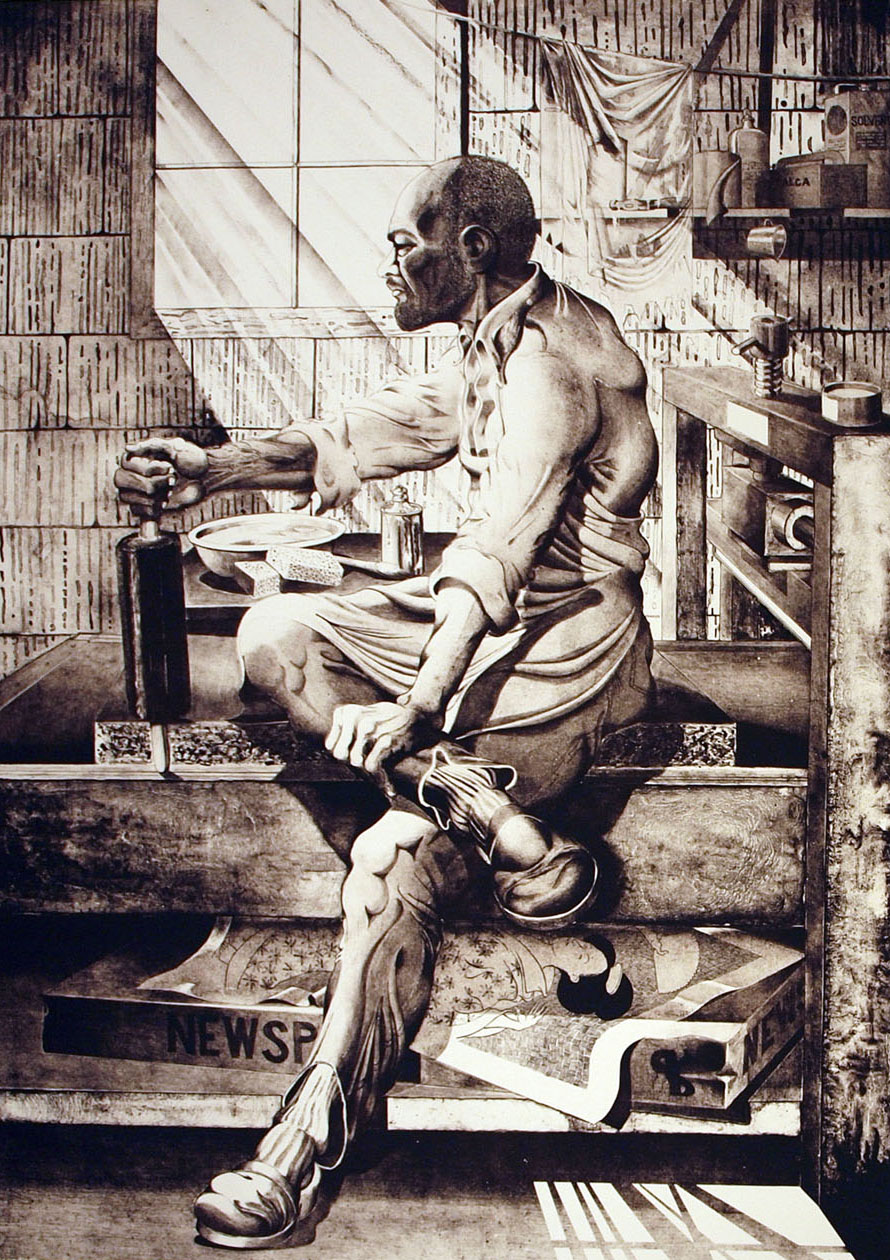
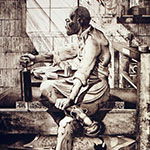
“Profile in Blue” by Ron Adams, 1988, Lithograph on Paper, Acquisitions Fund Purchase, 1994.005.0001
Before an image ever reaches a museum wall or a newspaper page, it passes through hands. Ink-stained, practiced hands that translate an idea into something reproducible, something shareable. In the world of printmaking, those hands often belong not just to the artist, but to the printer. Few artists understood that relationship more fully than Ron Adams.
Born in 1934 in Detroit, Adams trained across a wide range of institutions, studying drawing, technical illustration, and commercial art in Los Angeles. Throughout the late 1950s and 1960s, he took classes at Los Angeles City College, Los Angeles Trade Technical College, Manual Arts Adult Night School, the University of California-Los Angeles, and the University of Mexico. In 1963, he received a certificate of trade proficiency from Otis College of Art and Design, an institution that, at midcentury, served as a vital training ground for artists working at the intersection of fine art and industry. During this period, Otis was connected to a broader network of Southern California printmaking and design, where artists and artisans alike were redefining what print could be, bridging commercial techniques and experimental art practices.
In 1968, while studying at the University of Mexico, Adams designed posters, murals, and motifs for the Olympic Stadium in Mexico City. The 1968 Olympics were a globally significant cultural moment: the first Games held in Latin America, they were marked by bold graphic design and a strong visual identity, as well as political tension and protest. For an artist like Adams, participation in such a project placed him within an international conversation about image-making, public space, and the power of visual communication.
Upon returning to the United States, Adams joined the prestigious Gemini GEL (Graphic Editions Limited) workshop in Los Angeles. Founded in 1966, Gemini GEL quickly became one of the most important print studios in the world, known for its technical innovation and for fostering close collaborations between master printers and leading contemporary artists. It helped elevate printmaking from a reproductive craft to a primary artistic medium. Beginning as an assistant printer, Adams rose to the rank of master printer, working with major figures including Jasper Johns, Ellsworth Kelly, Robert Rauschenberg, and Frank Stella. In this environment, the printer was not merely a technician, but a collaborator, translating artistic vision into material form.
In 1973, Adams left Gemini to work briefly as a master printer for Editions Press in San Francisco. His short tenure there likely reflects the fluid and project-based nature of print workshops at the time, where printers often moved between studios to pursue opportunities or establish their own practices.
That next step for Adams came quickly. In 1974, he relocated to Santa Fe, New Mexico, where he founded Hand Graphics Ltd., a print workshop that would become a cornerstone of the region’s contemporary art scene. At a time when Santa Fe was expanding its reputation as an arts center, Hand Graphics provided artists with access to professional printmaking facilities and expertise that were otherwise difficult to find in the Southwest. Adams collaborated with and advised many significant artists, including John Biggers and Judy Chicago, and contributed to a growing network of artists working across media in New Mexico and beyond.
He also remained committed to education and community. In 1981, Adams served as a guest instructor in the printmaking department at the University of Texas-El Paso, a program notable for its engagement with borderland cultures and its emphasis on printmaking as an accessible, community-oriented medium. In 1985, he chaired the Santa Fe Committee for Low-Cost Studio Space for Artists, an initiative aimed at addressing one of the most persistent challenges artists face: access to affordable workspace. Such efforts helped sustain Santa Fe’s artistic community by ensuring that working artists could remain active participants in the city’s cultural life.
Adams sold Hand Graphics Ltd. in 1987, allowing the workshop to continue under new leadership while he turned his focus to his own artistic practice. He later served as an artist-in-residence at Hampton University in 1989, a historically Black university with a strong tradition in the arts. In 2002, he was also a resident artist at the Tougaloo Art Colony in Mississippi, a program known for supporting African American artists and fostering creative exchange in the South. Adams passed away in 2020 in Los Angeles, leaving behind a legacy that bridges art and craft, individual expression and collaborative production.
In Adams’ work, the human figure is central, particularly Black figures rendered with a striking sense of structure and presence. Musculature, bone, and sinew often appear subtly beneath clothing, not as signs of vulnerability, but of strength and endurance. This structural attention can be read as a visual metaphor for lived experience: the visible surface shaped by deeper histories, labor, and resilience.
As Kourtney Nicole writes in Ink Don’t Lie: Ron Adams and the Ritual of Black Printmaking, “The hand carries memory, and Ron’s hands were archives of resistance and rhythm.” Her observation points to the often-overlooked labor embedded in printmaking. The printer’s role, frequently uncredited, has historically been essential yet invisible, even as printers shape the final image as much as the artist does. Printmaking, in this sense, is a record not only of image but of process, collaboration, and labor.
The Roswell Museum’s Profile in Blue, purchased in 1994, offers a compelling glimpse into Adams’ practice. The work depicts a man in profile, seated in a moment of quiet reflection. He wears an apron and holds an ink roller in his right hand, suggesting his role as a printer. Beneath him, partially obscured, is a tray labeled “NEWSP” (likely “newspaper” or “newsprint”) overflowing with an image of a woman in traditional Japanese attire. Whether or not the figure is a self-portrait, the composition situates the subject within the physical and material world of print.
The title raises an intriguing question: why Profile in Blue when the image appears in black and white? In fact, the print exists in multiple states, including a six-color lithograph in which blue and yellow light streams through the window, illuminating the figure. Lithography, a process based on the chemical repulsion of oil and water, often involves multiple stages of proofing and revision. Black-and-white versions may serve as working proofs or as distinct editions, capturing different moments in the evolution of the image.
The presence of that “NEWSP” tray in Profile in Blue invites us to consider the broader world of print beyond the studio. Newspapers, like prints, are the product of skilled labor (writers, editors, designers, printers) working together to produce something meant to be seen, shared, and preserved. Established in 1897, the Roswell Daily Record has long served as one of those vessels of local memory, documenting the life of this community for well over a century. Like many small newspapers across the country, it reflects the rhythms, concerns, and stories of the place it serves. To value printmaking is, in some sense, to value the printed word as well: the tangible record of a community, made daily through the work of many hands.
The statement “It’s Your Art” is meant to emphasize that the Roswell Museum’s collection is your collection. Despite the museum’s closure due to the October 2024 flood, staff continue to work behind the scenes on care for and conservation of collection objects. Please stay tuned for more from the Roswell Museum. We appreciate the outpouring of support from the community during our closure. And remember, “It’s Your Art.”






.jpg)



.jpg)