by Aaron Wilder, Curator of Collections and Exhibitions at the Roswell Museum
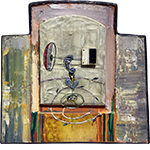
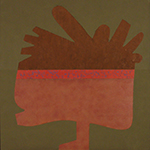
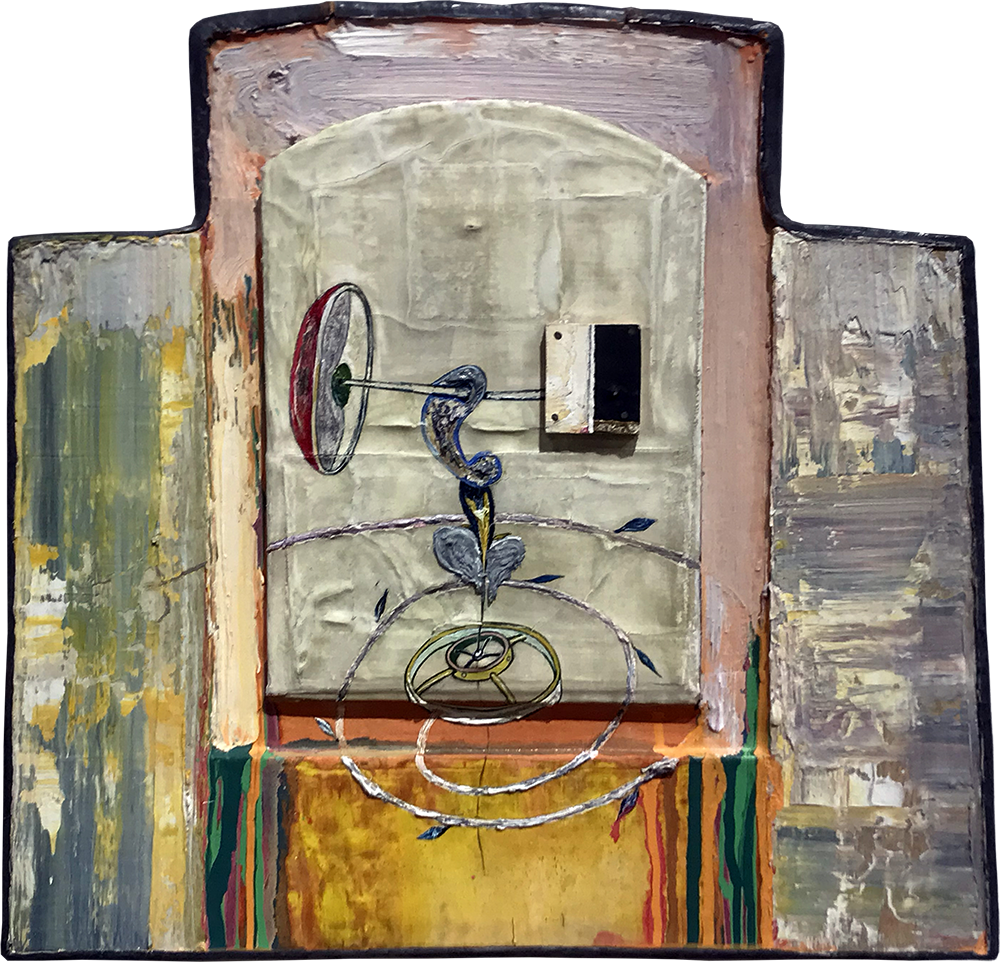
“Número Tres se va a Mormon Land” by Agustín Pozo Gálvez, 1989, Wood, Pigment, Metal, Gift of Stuart Arends, Roswell Museum Collection, 1992.010.0004
At first glance, Número Tres se va a Mormon Land (Number Three Goes to Mormon Land) by Agustín Pozo Gálvez might seem like a puzzle. A colorful, irregularly shaped panel holds a curious central form that suggests a balance or scale, with a circle at one end of its horizontal bar and a black-and-white square at the other. Beneath it, orange, red, blue, and green paint drips toward the bottom edge. The surface is thick with pigment, marks, and layers, as though the painting itself has accumulated memories along the way.
Born in Chile, Pozo Gálvez moved to the United States in 1968. His subsequent artistic development included an important period in the San Francisco Bay Area, where he studied at the College of Marin 1979-1982 before earning his BFA in 1984 and MFA in 1986 from the San Francisco Art Institute. He later taught at the University of California, Berkeley, and College of Marin.
These experiences placed him in a region with a rich and varied artistic community, while his continued connections to Chile remained part of his personal and artistic history. His paintings bring these experiences together not as straightforward autobiography, but through the symbols, gestures, and layers of meaning that invite viewers to make their own discoveries.
Pozo Gálvez was a Roswell Artist-in-Residence 2009–2010 and again in 2020–2021. The program has long brought artists from across the country and around the world to Roswell, giving them time and space to develop their practices while becoming part of the community’s creative life.
The artist also shares his life with fellow artist Susan Dopp, whose own connection to Roswell includes two residencies in 1988–1989 and 2007–2008. Dopp has written perceptively about her partner’s work, describing paintings in which the fragments of life are sometimes fractured and sometimes integrated, and urging viewers to look beyond the label of abstraction to discover the stories carried by gestures, patterns, and layers of color. In her writing, she sees Pozo Gálvez’s paintings as more than arrangements of shapes and pigments: they are places where ideas, contradictions, beauty, and uncertainty meet.
After Dopp suffered a stroke in spring 2023, Pozo Gálvez has spoken about taking his own painting practice more seriously. Their shared artistic lives offer another perspective on the ways creative practice can evolve alongside the experiences that shape us.
Created in 1989, this small but intriguing painting has been part of the Roswell Museum’s collection since 1992 when it was donated by artist Stuart Arends. Its unusual shape is one of the first things you notice about it. Rather than a conventional rectangle, the painting resembles an altarpiece.
Roswell Museum visitors last encountered it in 2023, when it was included in the exhibition Decades: The 1980s. For that exhibition, Pozo Gálvez returned to the painting to make some small repairs, renewing his connection with a work he had created more than three decades earlier.
When the October 2024 flood forced the museum to close, the painting was in storage rather than on view. Thankfully, it was not directly impacted by floodwaters.
When I recently asked Pozo Gálvez about the painting, he recalled returning to Chile and spending considerable time studying eighteenth-century polychrome religious sculptures at a regional museum in his hometown of Rancagua. These sculptures depicted saints and the Virgin Mary, their surfaces enriched with layers of color. He explained that his painting was not an attempt to reproduce that tradition, but rather an approximation of it. As he put it, the work refers to places of worship, while its underlying concerns reach beyond Catholic doctrine toward spirituality itself.
Rather than illustrating a particular religious story, the painting invites us to consider the forms and symbols through which people seek meaning. He described the image as a loose reflection on yin and yang, conceived as a weathervane. For him, it expressed his own journey from a Catholic upbringing toward an introduction to Eastern spiritual practices after coming to the United States.
The title has its own story, though even the artist offered it with some uncertainty. Pozo Gálvez recalled making three related pieces, with the third eventually sold to someone in Utah. That recollection may explain the reference to “Mormon Land,” but the title’s full meaning remains open to interpretation.
These details offer a glimpse into the many layers of thought that can inhabit a work of art. They do not, however, provide a single answer to every question the painting raises. The forms might remind one viewer of a scientific instrument and another of a sculpture. Those associations become part of the experience, even when they differ from the artist’s intentions.
Pozo Gálvez has spoken about the layers in his paintings as being full of information. During my recent visit to his home, he described how he sometimes changes the orientation of a painting’s surface as he works, allowing the process to develop through intuition rather than second-guessing every decision. When he looks at a finished painting later, he says, it can bring back the particular moment in which he made it.
That sense of accumulated experience seems especially fitting for this work. Its layered surface, distinctive architecture, and enigmatic imagery hold together without resolving into a simple explanation. The painting gives us room to look, wonder, and make connections of our own.
Those interested in seeing more of Pozo Gálvez’s work have an opportunity to do so locally. His paintings are currently featured in Echoes of Place, a two-person exhibition at Bone Springs Art Space with work by Roswell photographer Harold Lee Jones. The exhibition brings together two distinct approaches to the natural environment and humanity’s relationship with it and it's on view through October 31.
The statement “It’s Your Art” is meant to emphasize that the Roswell Museum’s collection is your collection. Despite the museum’s closure due to the October 2024 flood, staff continue to work behind the scenes on care for and conservation of collection objects. Please stay tuned for more from the Roswell Museum. We appreciate the outpouring of support from the community during our closure. And remember, “It’s Your Art.”